



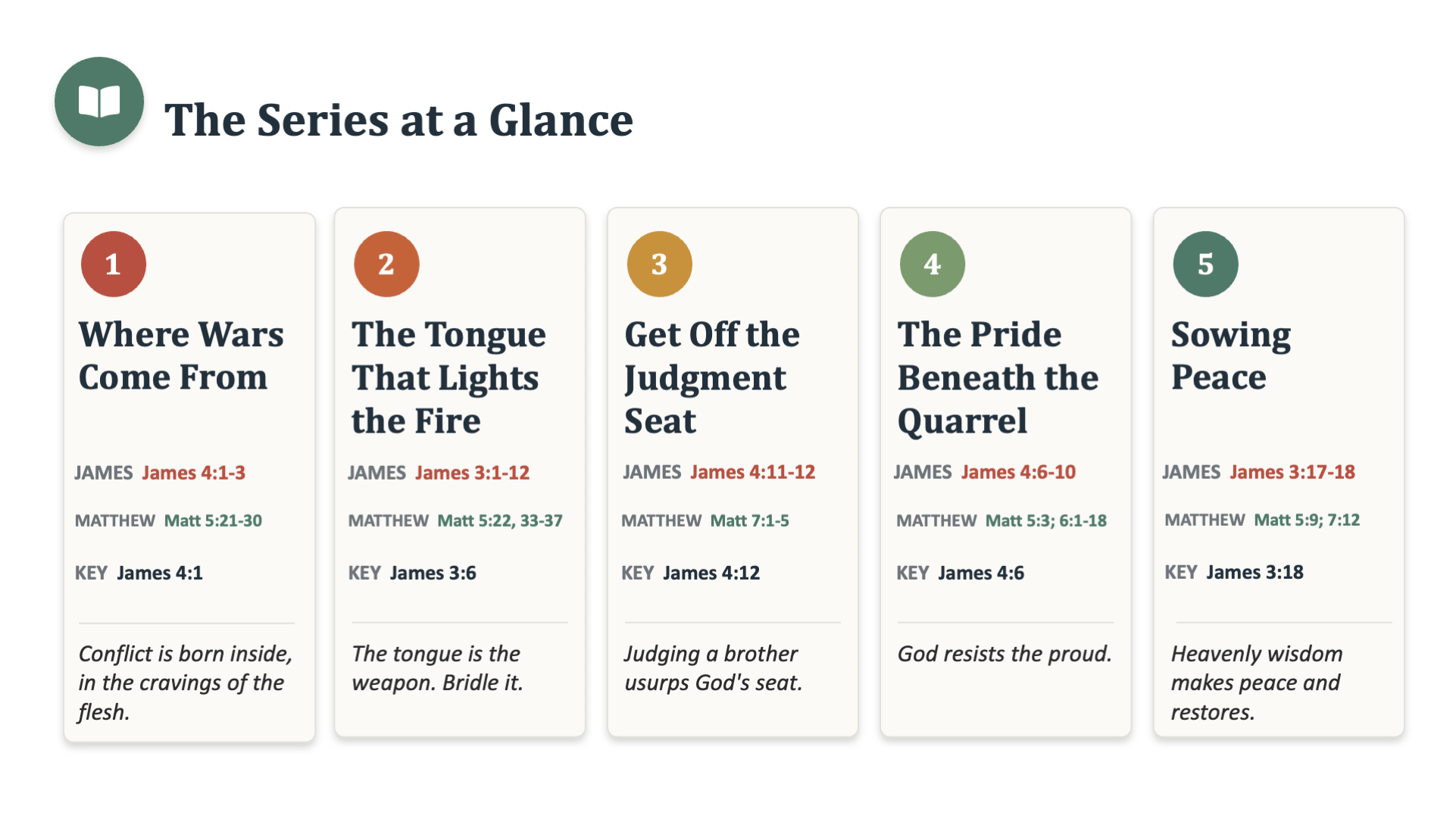
We’re in the middle of a series on conflict between brethren, and so far, James has refused to let us blame anyone else. In James 4, he traces every quarrel back to its source: the hungry appetite inside our own chest. The fix turns out to be spiritual, not tactical, and it works every time we have the courage to fully surrender ourselves.
Now James moves from the root to the weapon. When conflict is born, it has to be carried somewhere, and we’ve all seen exactly how it travels: it rides out of the heart on the tongue. If desire is what starts the fight, the tongue is what spreads it, and James gives the little muscle a whole chapter because he understands what every fire marshal understands — it doesn’t take much to burn down a great deal. One careless match in dry country, and you lose the forest.
He’s been building toward this since chapter one. Long before he calls the tongue a fire, he tells us to be “quick to listen, slow to speak, and slow to anger” (1:19). Three commands, and notice their order. Listening comes first, speaking comes second and slowly, and anger comes last and slowest of all. Most congregational conflicts run that list exactly backward. We’re quick to anger, quicker to speak, and we listen last, if at all.
How often we forget what James wrote back in chapter one: “Anyone who thinks he's religious but doesn't control his tongue deceives himself, and his religion is useless" (1:26). Useless. You can be at every service, sing every verse, carry your Bible with the worn cover, and undo all of it on the drive home with twenty seconds of the wrong words. James says a man like that isn’t fooling God or the people he wounded. He’s only fooling himself.
A Warning for the People Who Talk for a Living
Before James gets to the images, he aims a warning at a specific group: “Not many should become teachers, my brothers, because you know that we will receive a stricter judgment” (3:1). The first thing he says about the tongue is a caution to the people whose whole job is to use it.
Church fights often gather around the people up front. The ones who teach, who lead, who have the microphone and the platform and the influence, hold a tongue that carries farther than anyone else’s. When their speech goes wrong, the fire spreads faster and burns hotter, and James says they’ll answer for it under a stricter standard. He isn’t trying to scare people out of teaching. He’s reminding everyone who shapes a class or steers a discussion that the gift of words is also a weight, and the more reach your words have, the more carefully you’d better aim them.
Then he widens it back out to everyone: “For we all stumble in many ways. If anyone does not stumble in what he says, he is mature, able also to control the whole body” (3:2). This is the standard, and it’s also the prize. We all trip. But the person who can govern his mouth has proven he can govern everything else. James makes the tongue the test case for the whole Christian life. Master this, and you’ve shown you can master anything.
Small Thing, Enormous Steering
Watch how James stacks the images.
First, the bit. “Now if we put bits into the mouths of horses so that they obey us, we direct their whole bodies” (3:3). A thousand pounds of muscle, turned by a scrap of metal the animal could spit out if it understood its own strength. Then the rudder. A ship “though very large and driven by fierce winds” is steered “by a very small rudder wherever the will of the pilot directs” (3:4). The wind is enormous and the boat is enormous, and the thing that decides where all that mass ends up is a small board a man can move with one hand.
Both pictures say the same thing, and it’s about steering. A tiny instrument sets the course for something vastly larger than itself. James’s point lands in verse 5: “though the tongue is a small part of the body, it boasts great things.” Your tongue is small, and it is steering your whole life and half the lives around you. The size of a thing tells you nothing about the size of what it can move.
A Spark in Dry Brush
Now, the third image: “Consider how a small fire sets ablaze a large forest. And the tongue is a fire” (3:5-6). The bit and the rudder steer. Fire doesn’t steer. Fire consumes. James has shown us the tongue’s power to direct, and now he shows us its power to destroy, and he piles on the words: the tongue is “a world of unrighteousness,” it “stains the whole body,” it sets “the course of life on fire,” and it is itself “set on fire by hell” (3:6).
Think of how a wildfire is wildly out of proportion to its cause. Nobody plans to burn down a forest. Somebody leaves a campfire smoldering, or flicks a cigarette out of a truck window. And once it's going, it doesn't stay where it started. It jumps the road, it crowns the trees, it runs ahead of the people trying to fight it. That's a church conflict to the letter. One comment, repeated. One verdict, spoken out loud where it shouldn't have been. One "have you heard," and by the time anyone tries to put it out, it's three families and a called meeting and a wound that takes years to scar over. The fire never asks permission to spread, and it's never as small at the end as it was at the start.
And note where James says the spark comes from. The tongue is “set on fire by hell” itself. He will not let us treat a cruel word as a small, earthly slip. There’s a supply line running from below straight to the careless mouth, and the enemy is delighted to keep it stocked. The same chapter will soon call the rival wisdom “demonic” (3:15). James sees a spiritual hand behind the gossip we’d rather file under personality.
The Beast No One Has Caged
Now comes the teaching that should humble every one of us who has ever resolved to do better. “Every kind of wild animal, bird, reptile, and sea creature is tamed and has been tamed by humankind, but no one can tame the tongue” (3:7-8). Humanity has put lions in cages, taught dolphins to perform, broken wild horses to the saddle, and brought hawks back to the glove. We have tamed the whole animal kingdom. And we have never once tamed the three-inch muscle behind our own teeth.
The tongue is “a restless evil, full of deadly poison” (3:8). Restless, meaning it never settles, never finally gets safe, never reaches the point where you can stop watching it. And poison means the damage works beneath the surface. A poisonous word doesn’t always drop someone on the spot. It seeps. It gets into the bloodstream of a relationship and does its work slowly, and by the time anyone names the symptom, the venom’s been circulating for weeks.
If that sounds hopeless, it's meant to. The tongue can't be tamed because the tongue isn't the problem; it only reports what the heart is full of. Fix the source, and the speech takes care of itself.
Same Mouth, Same Sunday
Verses 9-10 show us the contradiction that fits a church fight better than any other, and it’s worse than mere meanness. It’s hypocrisy. “With the tongue we bless our Lord and Father, and with it we curse people who are made in God’s likeness. Blessing and cursing come out of the same mouth” (3:9-10). The same mouth. He doesn’t say the bitter people curse and the holy people bless. He says one mouth does both, and it could be yours and mine.
Picture the timeline. Ten o’clock, that mouth is lifted in worship, singing about Jesus, praying for the sick. By noon, the same mouth is in the parking lot taking a brother apart, or in the car on the way home reciting the case against someone who’s “made in God’s likeness.” Praise and poison, same Sunday, same lips, sometimes the same hour. James puts the two side by side precisely so we can’t keep them in separate compartments the way we’d like to. And then he refuses to let it pass: “My brothers and sisters, these things should not be this way” (3:10). No softening. This is not how it goes for people who belong to God.
He drives it home with pictures from the natural world, and they all say the same thing: this is against nature. “Does a spring pour out sweet and bitter water from the same opening? Can a fig tree produce olives, my brothers and sisters, or a grapevine produce figs? Neither can a saltwater spring yield fresh water” (3:11-12). A spring is one thing or the other. A tree bears after its kind. Nature doesn’t run both ways out of the same source, and James is quietly making a point about the heart. When blessing and cursing come from the same mouth, something at the source is wrong. A double tongue is the symptom of a divided heart. Remember, the war inside became the war among us.
Tie to the Sermon on the Mount
James is preaching his brother’s sermon, and on the subject of the tongue, the family resemblance is unmistakable.
Start with the worst-case word. When Jesus intensified the command against murder, notice the sentence he uses: “Whoever insults his brother will be subject to the court. Whoever says, ‘You fool!’ will be subject to hellfire” (Matthew 5:22). A contemptuous word, and Jesus puts hellfire on the table for it. Now lay that beside James: the tongue is “set on fire by hell” (3:6). Jesus says the cruel word lands you in the fire; James says the fire is what lit the word. They’re describing the same blaze from opposite ends, and both of them refuse to call a word “just words.”
There’s a second link that runs even deeper. It goes past the tongue to what’s behind it. Jesus said, “The mouth speaks from the overflow of the heart” (Matthew 12:34). The tongue is not the source; it’s the spillway. Whatever the heart is full of eventually comes out of the mouth, usually under pressure. That’s why James can’t fix the church by fixing its speech, and why no one can tame the tongue by sheer effort. The mouth is just reporting on the heart. And Jesus adds: people will “give an account” on the day of judgment “for every careless word they speak” (Matthew 12:36). These are the throwaway comments, the jokes at someone’s expense, the thing you said because it was clever and never thought about again. Heaven kept the receipt.
Then there’s the parallel that’s nearly a quotation. James 5:12 lands right on top of Matthew 5:33-37. James says don’t swear oaths at all; instead, “let your ‘yes’ mean ‘yes,’ and your ‘no’ mean ‘no’” (5:12). Jesus says the same in Matthew 5:37. Both are calling for speech so trustworthy it needs no contract. And there’s a quiet point about conflict buried in it. In a congregation at peace, your plain word is enough. The moment people start demanding oaths and guarantees and “swear to me,” the tongue has already done its damage; trust is already gone. Healthy speech doesn’t need to be notarized.
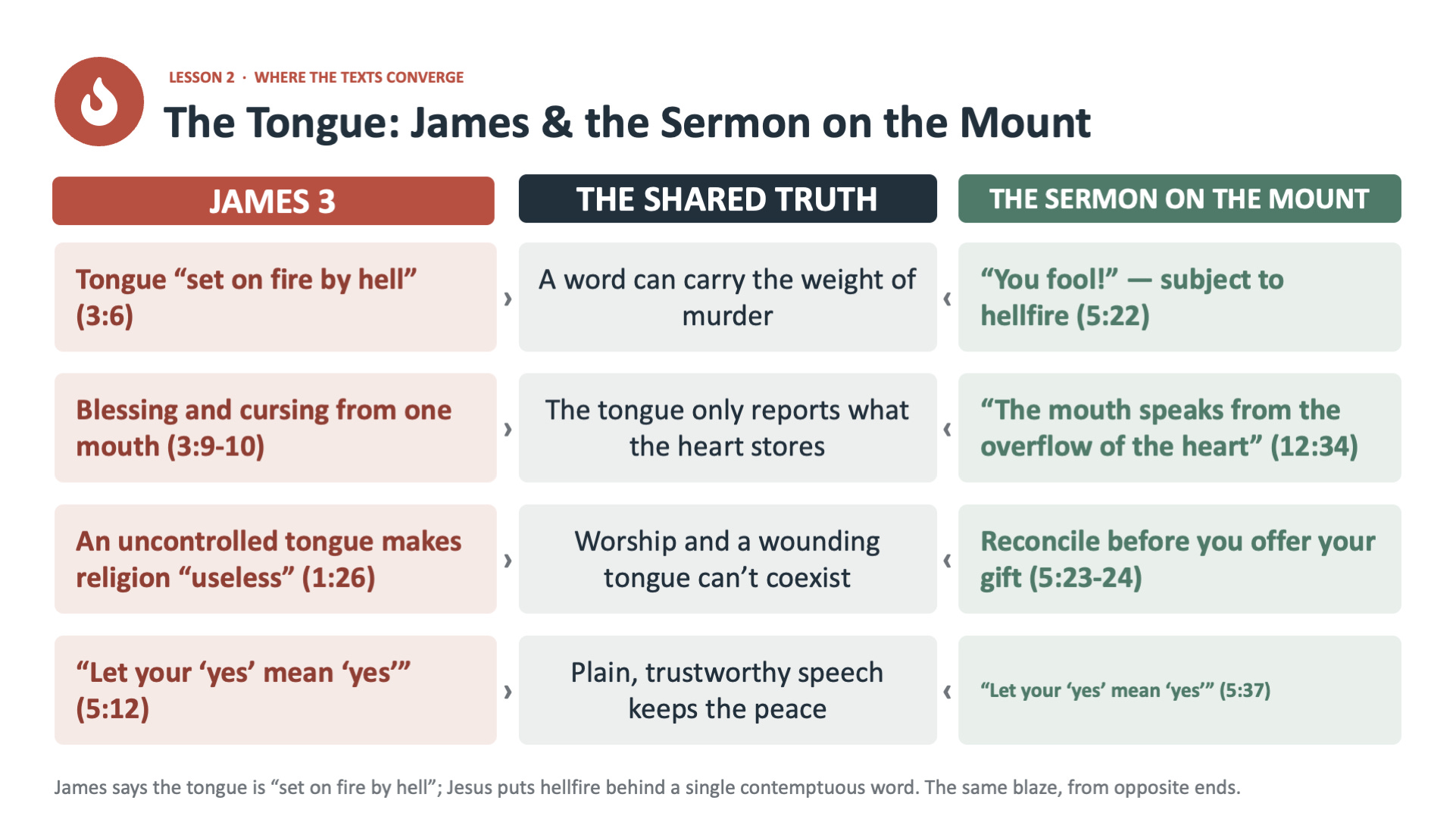
Stay with that second link a moment longer, because it's at the heart of the whole lesson. If the mouth only reports on the heart, then a clean tongue is downstream of a clean heart, and that’s where James has been headed since chapter one. You don’t get peaceable speech by gritting your teeth. You get it the way you get sweet water from a spring: by changing what’s at the source.
Bridling, Not Silencing
It would be easy to walk away from this chapter thinking the goal is silence. It isn’t, and James is careful to say so. Twice, he reaches for the image of a bridle, not a muzzle. The religious man who “doesn’t control [bridle] his tongue” has a useless religion (1:26), and the mature man who doesn’t stumble in speech can “control the whole body” the way that bit controls the horse (3:2-3). A bridle doesn’t kill the horse. It steers it. The aim isn’t a congregation too frightened to speak; it’s a congregation whose speech is aimed.
Frightened silence is its own kind of conflict, just a colder one. A church where people have learned that honesty gets punished isn't peaceful. It's pressurized. The tongue James wants is one that is governed. Slow to wound, quick to heal. Quick to listen, slow to speak. The same tongue that can torch a forest can also speak the word that puts a fire out, and James wants that tongue free to do its good work.
Where the Power Has to Come From
So we’re left with the problem that the chapter set up and seemed to leave hanging. No one can tame the tongue (3:8). If that’s true, the whole lesson is a counsel of despair, unless the power to bridle it comes from somewhere other than us.
It does, and James has been pointing at it the entire time. The words only carry what the heart already holds, which means the only way to change the speech is to change the supply. You can't dam a poisoned spring; you have to deal with the poison. And the next paragraph in James tells you where the clean water comes from: "the wisdom from above is first pure, then peace-loving, gentle, compliant" (3:17). The tongue gets bridled not by sheer effort but by a heart that's been remade from above, drawing on a wisdom God "gives to all generously" when we finally ask for it (1:5). The reason we can't tame the tongue ourselves is the very reason we have to take it to God.
Bringing It Home
Most conflicts among brethren would die within a day if the tongue simply stopped feeding them. The text you don’t send. The comment you don’t repeat. The defense you don’t fire back across the room. James says the person who never stumbles in what he says is “mature,” able to govern his whole life (3:2). Get the tongue under God, and you’ve put out most of the fire before it ever reaches the tree line.
But the deeper handle is the one Jesus hands us: the mouth speaks from the overflow of the heart. So the real question isn’t only “how do I watch my words.” It’s “what is my heart so full of that this keeps spilling out?” Bitterness fills a mouth with bitter water. Envy fills it with sharp little comparisons. Pride fills it with verdicts. Watch what comes out under pressure, and you’ll learn what’s stored up inside, and then you’ll know what to take to God. Bridle the tongue, yes. But ask Him to clean the spring, because that’s the only thing that finally works.

Man oh man.....that was a great read.My gossip and unbridled tongue are both something that disturb me,I keep telling myself that I'll get better the more I learn about our Lord and the closer I get to him.Definitely something I'm going to start really praying and working on.....Thank you