



It was a nighttime conversation. Private. Careful. Nicodemus came after dark. He was a Pharisee, a member of the Sanhedrin, a man who had spent his entire life studying the scriptures. He’d seen enough of Jesus to believe something was happening. He just couldn’t fit it into any category he already had.
And Jesus, in the middle of explaining what it means to be born again, reaches back eight centuries and grabs a story from the wilderness.
Just as Moses lifted up the snake in the wilderness, so the Son of Man must be lifted up, so that everyone who believes in him may have eternal life. (John 3:14–15)
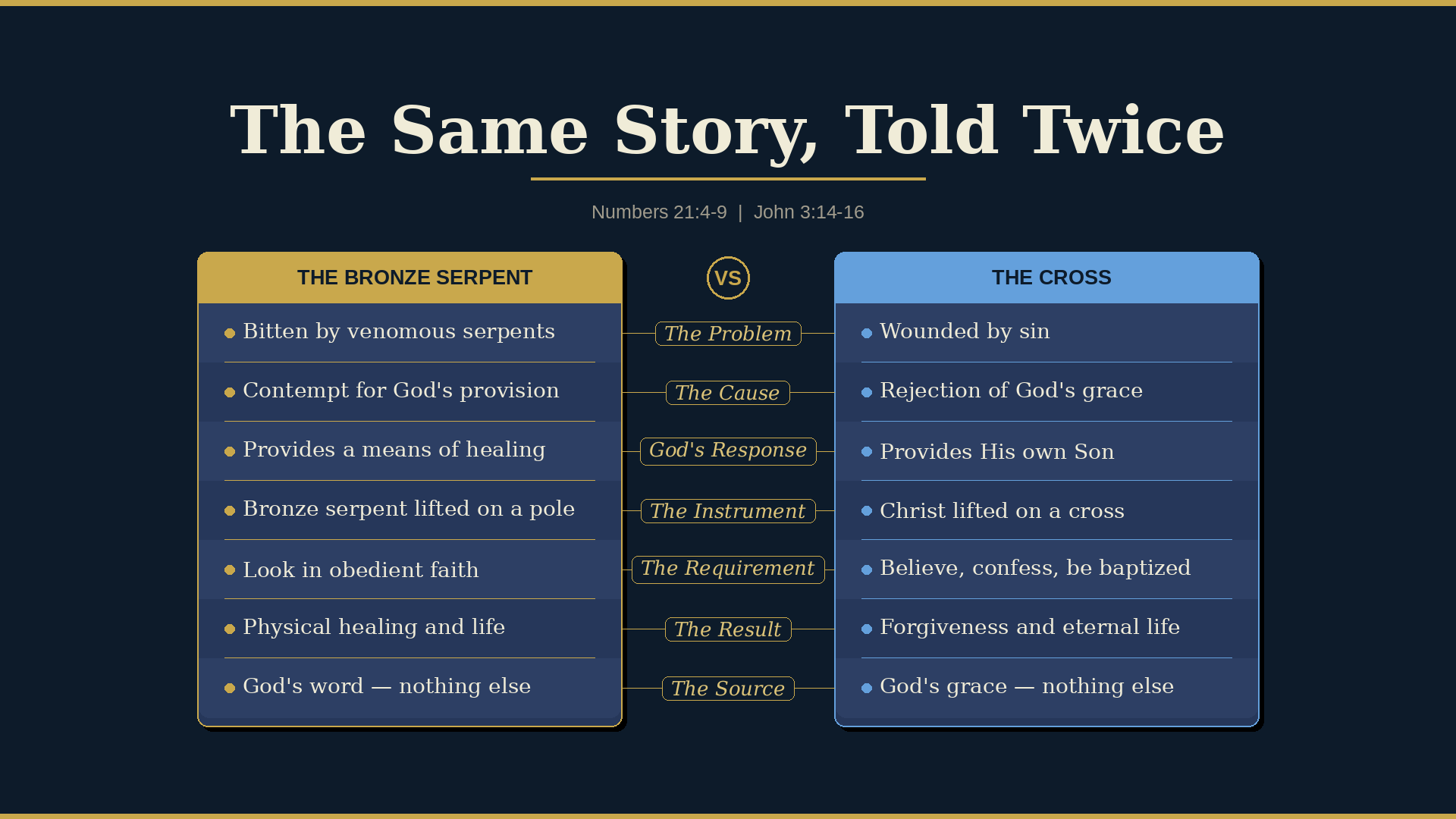
Of all the stories He could have chosen, and He knew every one of them, He chose this one. The strange one. The one most people would have found embarrassing to bring up. A bronze serpent on a pole. And that choice is worth thinking about carefully, because Jesus didn’t reach for illustrations carelessly.
Here’s what He was pointing to. Israel in the wilderness, grumbling again, contempt for God’s provision, again. Venomous snakes, people dying, and finally an honest confession: We have sinned. God’s response was not to sweep the consequences away. He told Moses to make a bronze serpent, lift it on a pole, and tell the people: “Look at it and live.”
No explanation. No ritual. No earning it. Just this: trust what God said and respond.
That’s the story Jesus handed to Nicodemus as the key to understanding the cross. And the more you see the parallel, the more precise it becomes.
In both cases, the problem is real, and the damage is done. Israel wasn’t imagining the snakes. We aren’t imagining sin. Paul makes this painfully clear in Romans: all have sinned and fall short of the glory of God. (Romans 3:23) The consequence is just as real: the wages of sin is death. (Romans 6:23) There’s no softening that. The wilderness story didn’t soften the snakes either.
In both cases, the remedy comes entirely from God. Israel didn’t negotiate a solution. They didn’t contribute to the design of the bronze serpent. God provided the means, God announced the promise, and God did the healing. The cross works the same way. Paul writes that God made him who had no sin to be sin for us, so that in him we might become the righteousness of God. (2 Corinthians 5:21) This is entirely God’s initiative. Entirely God’s provision. We bring nothing to it except our need.
In both cases, the remedy looks wrong. The bronze serpent was offensive in its simplicity… you want me to just look at that thing? The cross was worse. Paul didn’t minimize this: the message of the cross is foolishness to those who are perishing. (1 Corinthians 1:18) It looked like defeat. The disciples couldn’t make sense of it the night it happened. The religious leaders saw it as confirmation. Even today, the idea that a Roman execution two thousand years ago is the hinge point of human history strikes a lot of people as absurd.
But that’s precisely what God does. He takes the instrument of death and makes it the means of life. He took the serpent, the very symbol of the judgment, and made it the instrument of healing. He took the cross, the symbol of shame and defeat, and made it the power of God and the wisdom of God. (1 Corinthians 1:24)
In both cases, the only requirement is faith expressed through obedience. The people in the wilderness who looked and lived weren’t smarter, or better, or more deserving than those who didn’t. They simply believed God meant what He said and acted on it. The writer of Hebrews describes faith as the assurance of things hoped for, the conviction of things not seen. (Hebrews 11:1) That’s exactly what looking at the bronze serpent required. Nothing visible guaranteed it would work. Just a promise from God, and a choice to trust that promise.
John doesn’t leave us guessing about what this means on the other side of the cross. Just two verses after Jesus mentions the lifted serpent, he writes what may be the most recognized sentence in all of Scripture: For God so loved the world that he gave his one and only Son, that whoever believes in him shall not perish but have eternal life. (John 3:16)
That verse doesn’t arrive in a vacuum. It lands immediately after the image of the serpent lifted in the wilderness. It’s the explanation of the picture. The bronze serpent, lifted up, was God sketching in miniature what He was always planning to do on the largest possible scale.
And the word whoever is doing a lot of work in John 3:16. Not whoever earns it. Not whoever understands it fully. Not whoever has their life together first. Whoever believes. Whoever looks. The same uncomplicated, humbling, equalizing invitation as the wilderness, available to every person, in every condition, at every point of failure. No one is too far gone. No one has drifted beyond the reach of what God has provided. The only question is whether we're willing to receive it on His terms.
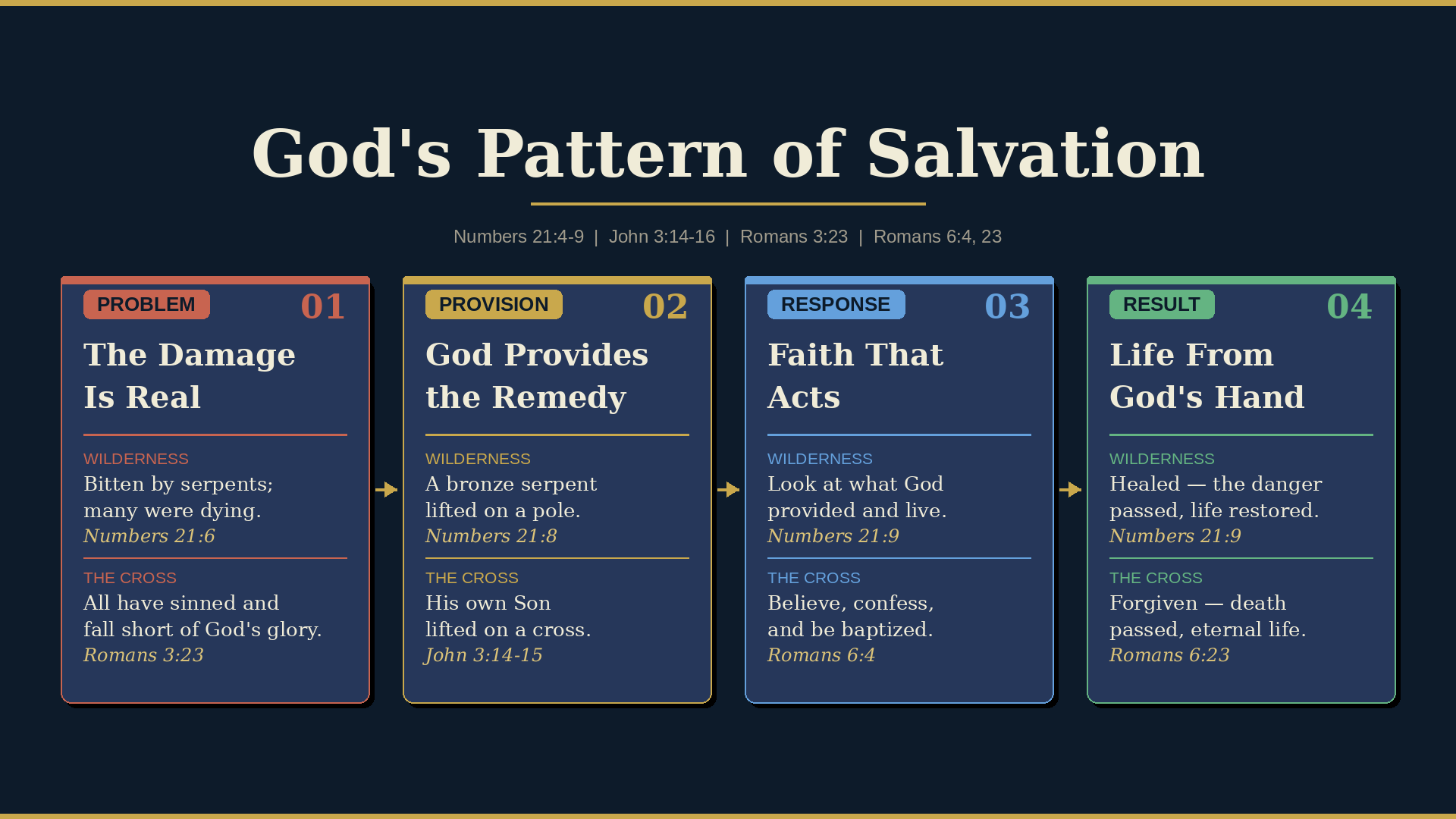
Paul summarizes the grammar of this salvation with a phrase that still echoes the wilderness: if you confess with your mouth that Jesus is Lord and believe in your heart that God raised him from the dead, you will be saved. (Romans 10:9) But Paul himself is the one who completes the picture. Earlier in Romans, he connects that saving faith to baptism, being buried with him through baptism into death so that, just as Christ was raised, we too may live a new life. (Romans 6:4) Faith that looks to Christ doesn’t stop at belief. It moves. It acts. It goes through the water.
That’s not incidental. It’s the same pattern as the wilderness. Israel didn’t just look at the far shore and believe they could cross. They stepped into the sea. The Israelites who looked at the bronze serpent didn’t just agree it was probably a good idea. They looked, an act of trust expressed in obedience. And Paul, writing to the Corinthians, makes the connection explicit: Israel was baptized into Moses in the cloud and in the sea. (1 Corinthians 10:2) Their crossing was their baptism. Their deliverance was entered, not just acknowledged.
Salvation has always looked like this in God’s design, not something you think your way into, but something you receive by trusting God enough to do what He said. The snake on the pole. The Son on the cross. The waters of baptism. Each one asking the same question: do you trust God’s word enough to act on it?
Look. And live.

Wow!!! Great read!!! I have read over that, so many times and never even thought about it. Wow. Nothing in scripture is there by chance. All of it for a purpose, and I love how if we chew and digest the spiritual food, we learn and grow!! Amazing! But great article!!!