
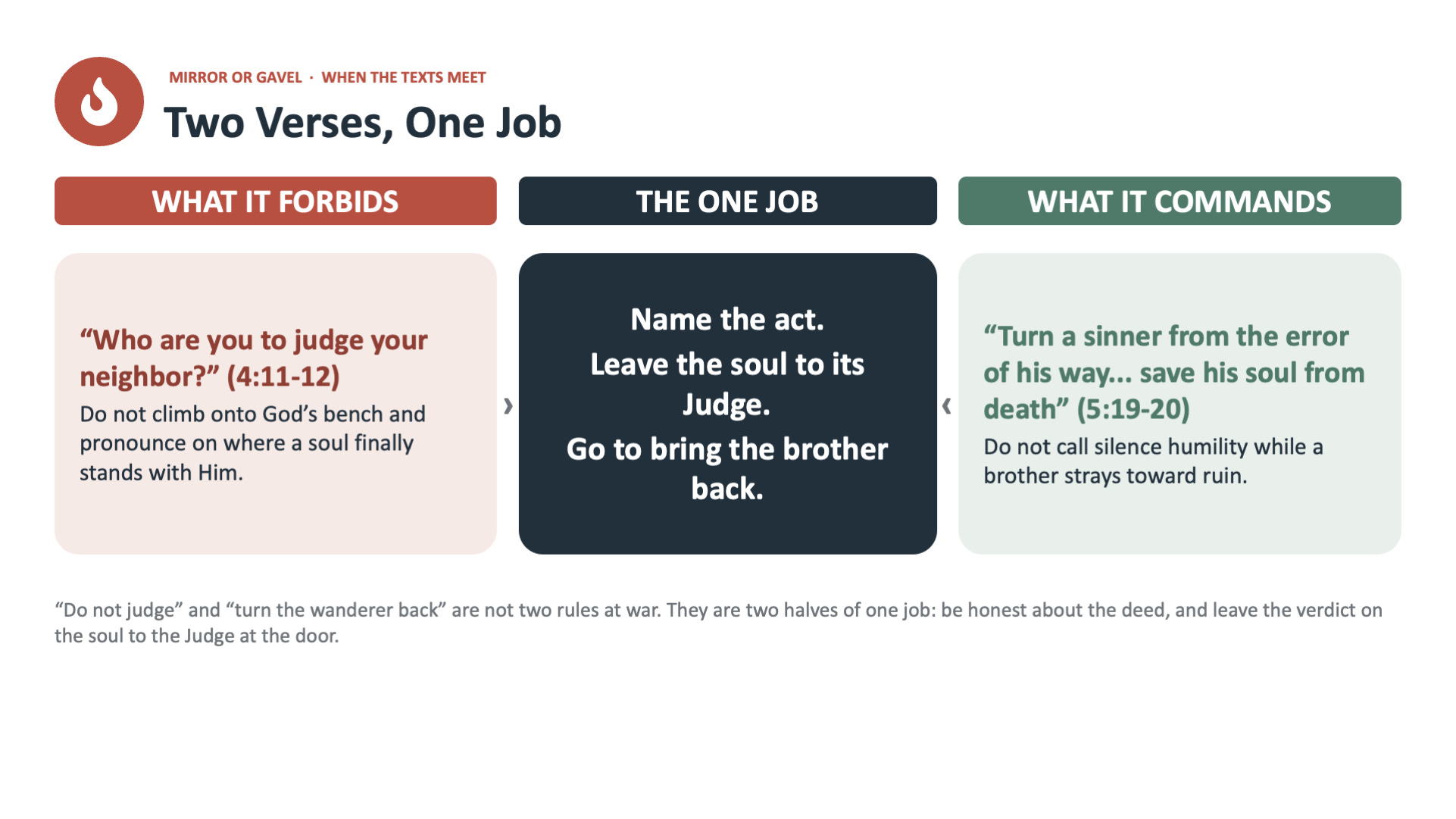
“There is one lawgiver and judge who is able to save and to destroy. But who are you to judge your neighbor?” (James 4:11-12).
“My brothers and sisters, if any among you strays from the truth, and someone turns him back, let that person know that whoever turns a sinner from the error of his way will save his soul from death and cover a multitude of sins” (Jas 5:19-20).
Two Passages Side by Side
Taken together, these two passages seem to pull in opposite directions. In chapter four, he asks, “Who are you to judge your neighbor?” and binds the judging to slander, calling it a reach for a seat that isn’t ours. In chapter five, in the last lines of the letter, he commands the church to go after a brother who “strays from the truth” and turn him back, and says that the one who does so “will save his soul from death.” So which is it? Hands off, or go get him?
The answer is both, actually. The trouble is that we hear “do not judge” and “go correct your straying brother” as a contradiction, when James heard them as two halves of one job. You can’t turn someone back from an error you refuse to call an error. Some judgment of the act is built right into the rescue. The man drowning forty yards offshore does not need you to withhold all opinion about whether he’s in the water. He needs you to be sure he’s in the water and then to swim.
So the question we’re examining is a practical one a real congregation has to answer almost all the time. Where is the line? When is naming a sin the loving thing Jesus and James both command, and when is it the proud, self-appointed judging they both forbid? Go too far in one direction, and you produce a harsh church that crushes people. Go wrong in the other, and you produce a timid church that watches them walk off a cliff and calls its silence humility. Neither is what James wants. He wants a people who can tell a mirror from a gavel.
The Line Runs Between the Act and the Soul
Now, there is a line, and it runs between the act and the soul or between the splinter and the eternal verdict.
You are equipped, and even commanded, to look at conduct against the standard of Scripture and call sin what God calls sin. That is not arrogance. That is reading the book and believing it. When a brother is in adultery, naming it adultery is not you climbing onto a throne. It is you agreeing with the throne. The same goes for gossip, drunkenness, or the slow drift out the back door of the faith. Scripture has already rendered the verdict on the behavior. Repeating that verdict is obedience, not pride.
What you are flatly forbidden to do is crawl into God’s chair and pronounce on where a soul finally stands with Him. That is the part you cannot see and were never given. You cannot read the heart that produced the behavior. You weren’t there for the whole story. You can’t weigh the fear, the history, the half-repentance already underway in private. And you certainly can’t save or condemn a soul, which is the very thing James says the “one lawgiver and judge” alone can do. So the act is fair game for honest evaluation. The soul belongs to Someone else’s bench.
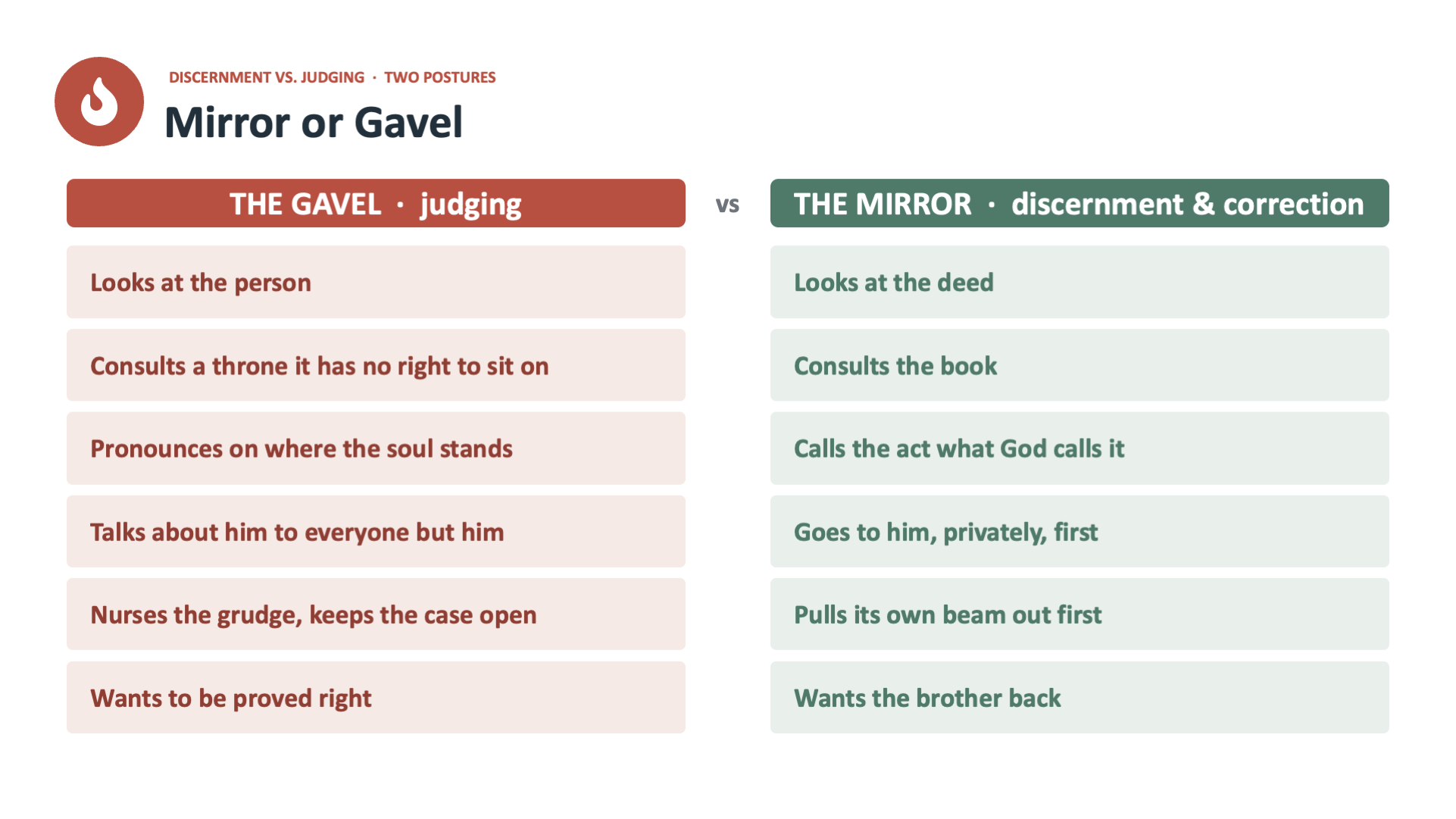
Two short sentences capture the whole difference. Discernment looks at the deed and consults the book. Judging, in the sense James condemns, looks at the person and consults a throne it has no right to sit on. One is loving correction with your own beam already removed. The other is playing God.
What This Looks Like on the Ground
How we choose to apply this theology in ordinary moments is important. Here is the difference in the situations a congregation could face.
A report comes to you about a brother. The gavel takes the report, fills in the motive, and forwards it to one more person “so we can pray about it.” The mirror does what Jesus said in Matthew 18: it goes to the brother, privately, first. The test is direction. Are you moving toward the person or talking about him to everyone but him? A church full of mirrors has very short rumor chains because the conversation keeps ending up face-to-face with the only person who can do something about it.
A member is genuinely drifting, missing services, or slipping into something that will wreck him. Timidity says, “Who am I to say anything?” and lets him go down quietly, then calls that humility. That is not what James means, and James 5:19-20 is the proof. The rescue is commanded. So someone goes, and the mark of the mirror is what he leads with: the deed measured against Scripture, not a verdict on the man’s heart. “Here is where you’re headed, and you matter too much to watch it” is correction. “You were never really converted” is a sentence only God can pass.
You sit under a lesson or a decision you don’t like. The Berean of Acts 17:11 checks the teaching against the book openly and can disagree without contempt. The judge skips the text and goes straight to the motive: “He only said that to take a shot at us.” You can evaluate a lesson all day long; that is exactly what the Bereans were praised for. What you cannot do is read the why behind it, and the moment your complaint is about his heart instead of his argument, you’ve climbed into the chair.
Someone sins against you personally. The gavel keeps the case open, recites it to a spouse, nurses the grudge James warns about when he says “the judge stands at the door” (5:9). The mirror remembers Matthew 7:5, deals with its own beam first, and goes to forgive and restore rather than to win. The two can look almost identical from the outside, so test them by their aim. Are you trying to get the brother back, or be proven right?
The elders or a teacher must address sin in the body. This is the place people most often confuse the two, usually by accusing faithful correction of being “judging.” Calling adultery adultery is not the judging James forbids. Shepherds are supposed to look at conduct and call it what God calls it. What they are forbidden to do is pronounce on where a soul ultimately stands with God, or hand out the discipline with a sneer instead of tears. Same act, two completely different spirits, and the congregation can feel which one is in the room.

Bringing It Home
The local church does not have to choose between being honest and being kind. That is the false choice James refuses. The harsh church and the timid church are making the same mistake from opposite ends: both have confused naming a deed with sentencing a soul. The harsh church sentences and calls it faithfulness. The timid church refuses to name and calls it grace. Neither is the wisdom from above.
The way through is the same four habits, lesson by lesson. Speak to the deed, which you can see, and leave the soul, which you can’t, to the Judge at the door. Go to the person, not about him. Pull your own beam first, the way pride never wants to. Aim every word at restoration, not victory. A church that practices those four things ends up honest and gentle at the same time, which is exactly the combination most congregations assume they have to pick between. James says you don’t. You just have to know the difference between a mirror and a gavel, and have the humility to keep choosing the mirror.