


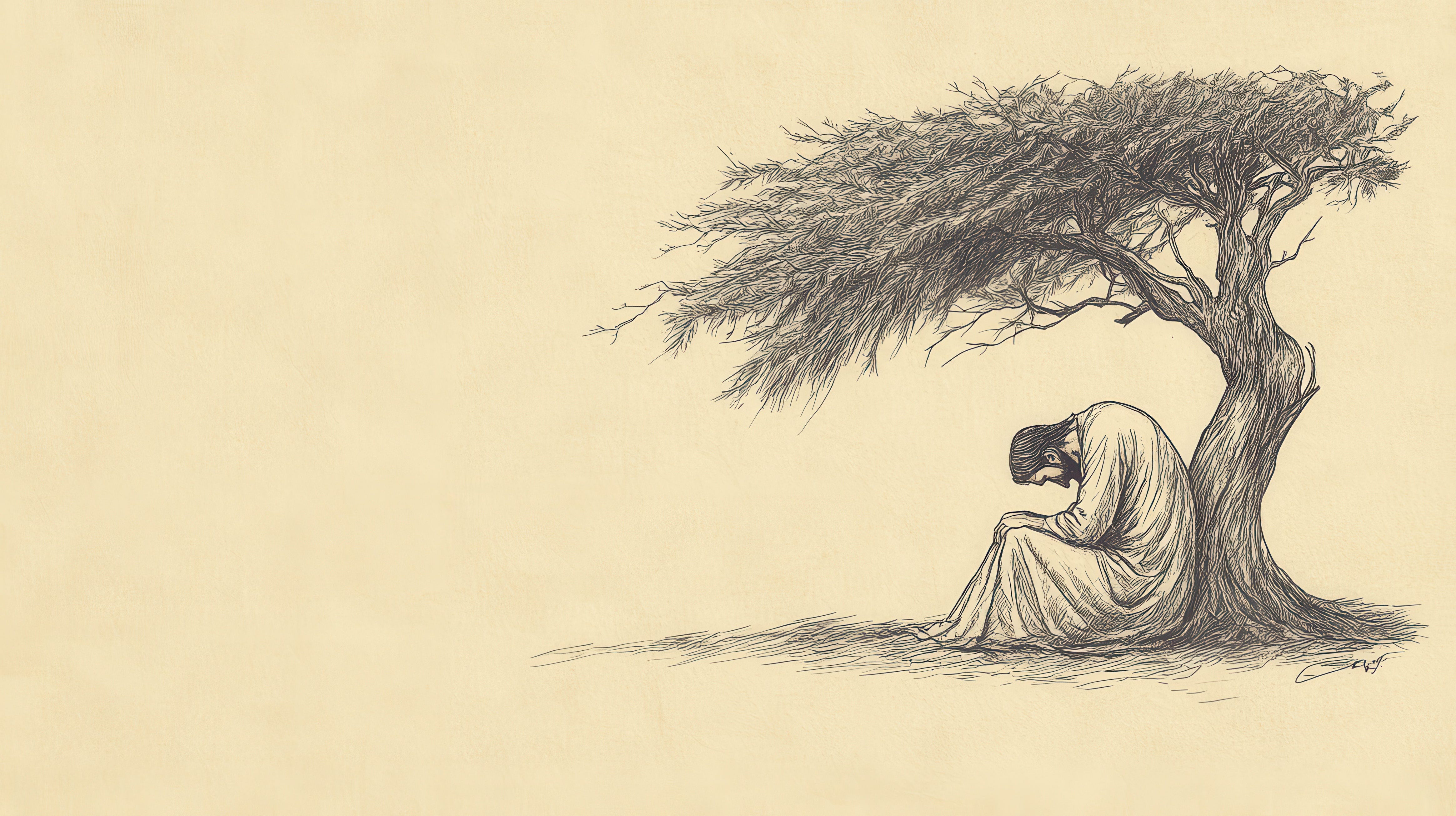
Yesterday, we sat with Elijah under the broom tree. A prophet who had just called down fire from heaven, now flat on the ground, asking God to take his life. And what struck us most was what God refused to do. He never shamed Elijah for being weak. He never told him to snap out of it. He never threatened to leave. He drew near instead.
That tenderness leaves us with an uncomfortable question. If that is how God Himself handles the wounded, why do His people so often do the opposite?
Then he lay down and slept under the broom tree. Suddenly, an angel touched him and said, “Get up and eat.”
— 1 Kings 19:5
Say the words “anxiety,” “depression,” or “therapy” in some church circles, and watch the room tighten. Someone will remind you that God’s Word is sufficient. Someone will quote a verse. And the quiet person two rows back — the one who has been struggling in the dark for months — will decide, one more time, to say nothing.
That silence is what concerns me. So let’s talk about it.
God Works Through What He Made
God is the Great Physician. But notice how often He heals through ordinary means.
He gave Hezekiah fifteen more years of life — and then told Isaiah to put a lump of figs on the boil (2 Kings 20:7). He could have healed with a word. He used a simple home remedy instead.
Paul told Timothy to stop drinking only water and to use a little wine for his stomach and his frequent illnesses (1 Timothy 5:23). That is plain medical advice, tucked right into inspired Scripture.
And Luke, who traveled with Paul and wrote a fourth of our New Testament, was a doctor (Colossians 4:14). The Holy Spirit did not treat his training as a rival to faith.
Going to a doctor does not replace God. God made the body. He gave people the wisdom to understand it. When you sit in that office, you are not leaving the Lord behind. You are receiving what He provides. The mind is part of what He made, too.
Look at the Broom Tree
Elijah had just called down fire from heaven. Days later, he was sitting under a tree, begging God to let him die. “I have had enough, Lord,” he said. “Take my life” (1 Kings 19:4).
This is one of the boldest men in the whole Bible. And he is done.
Now watch what God does. He does not rebuke him. He does not say, “Where is your faith?” He sends an angel who does two things: feeds him and lets him sleep. Then He does it again. Bread and rest. Bread and rest.
Only after Elijah’s body had been cared for did God meet him in the soft whisper (1 Kings 19:12).
God tended to the exhaustion before He addressed the theology. He knew the body keeps the score. Sometimes a soul is not in rebellion — it is depleted. And the holy response to a depleted person is not a lecture. It is care.
The Word Behind “Therapy”
Did you know our word for “therapy” comes straight out of the Greek New Testament? The word is therapeúō (θεραπεύω). It runs all through the Gospels. Over and over we read that Jesus “healed” the sick — therapeúō. It carries the idea of tending, caring for, restoring, serving.
So when someone sneers that “therapy” is a worldly invention, the word itself was borrowed from the healing ministry of the Lord Jesus. To tend a hurting person back toward wholeness is not the world’s idea. It is Christ’s.
The Bible Is Enough — and That’s Exactly Why
Now hear the other side, because it is important too. Scripture is sufficient. “All Scripture is inspired by God and is profitable … so that the man of God may be complete, equipped for every good work” (2 Timothy 3:16–17). The Word is our final authority. No counselor stands over it.
But look closely at what the Bible says about itself. It equips us for righteousness. It makes us complete for godliness. It does not claim to be a manual for setting bones or a chart for brain chemistry. A man can love every word of Scripture and still need a cast on his arm.
And here is the part many people miss: the Bible itself sends us to wise counsel. “Plans fail when there is no counsel, but with many advisers they succeed” (Proverbs 15:22). “Confess your sins to one another and pray for one another, so that you may be healed” (James 5:16). God’s own Word tells us we were never meant to carry our burdens alone.
The danger the critics name is real. Counsel cut loose from truth can drift, and our culture can turn the counselor’s couch into a substitute for the prayer closet and the assembly. We should never look back to Egypt. But the answer to bad counsel is not no counsel. The answer to a poor doctor is a good one — not the refusal of all care.
The Burden Jesus Never Gave
I wonder if there’s something deeper under all of this. Somewhere along the way, a quiet works-theology settled into the church. Not the good call to obey God, but the idea that our standing with Him rises and falls on our spiritual performance. In that way of thinking, a strong Christian never struggles. So if you’re struggling, you must not be trying hard enough. Pray more. Read more. Believe harder. And if the darkness still won’t lift, the fault must be yours.
But that’s not the gospel. We are saved by grace, through an obedient faith, not by the strength of our feelings or the size of our willpower. Our hope rests on Christ, not on how well we’re holding up this week. When we forget that, we hand hurting people a burden Jesus never gave them. And we teach them to hide.
For the Ones Afraid to Speak
This part is really for you.
You love the Lord. You read your Bible. You pray until your knees ache. And the heaviness still comes. You have started to wonder if your struggle is a sin — if real faith would have fixed it by now. So you put on the smile, sit in your pew, and tell no one.
Hear me. You are not weak. You are wounded. Those are not the same thing.
Getting help is not a step away from God. It can be a step of obedience — stewarding the body and mind He gave you, leaning on the people He set around you, trusting that He still works through means.
Still, use wise discretion in whom you trust. Not every counselor shares our faith, and some build on a foundation very different from Scripture. So choose with care. Look for help that honors God’s truth rather than working against it. And remember this: the Lord’s church is full of capable people. Some of the godliest folks I know do this work for a living. Seek them out.
Read your Bible. Pray. And when the weight is more than you can carry alone, reach for help. Your heart and your mind are worth caring for.

I do so agree with this! I will say that I long for the brotherhood to be more supportive directly. James 5 clearly teaches to take physical and spiritual sickness to our brethren. We are meant to work these things out together. Maybe it is in the form of having someone to pray with before you go to the doctor and then someone to pray with about the information gained from the doctor. Maybe it is in the form of being able to share with your brethren your heavy heart and brethren not treat you as though you are broken and runaway because they do not know how to help.
It is not the need that is the problem. Our lack of trust in God's word to support us while we support others may be the problem. Compassion is gained through God's word, but it must be worked like a muscle to grow strength in order to share.
Once again brother you nailed it o have been in therapy for grieving after I lost my wife after 40 years of marriage. I suffered from separation anxiety. 😟 it just about took me out. But I’m here today to tell you and anyone else that is reading this get the help you need. No excuses no shame. Never think that you can make it alone because you are not alone. God bless