


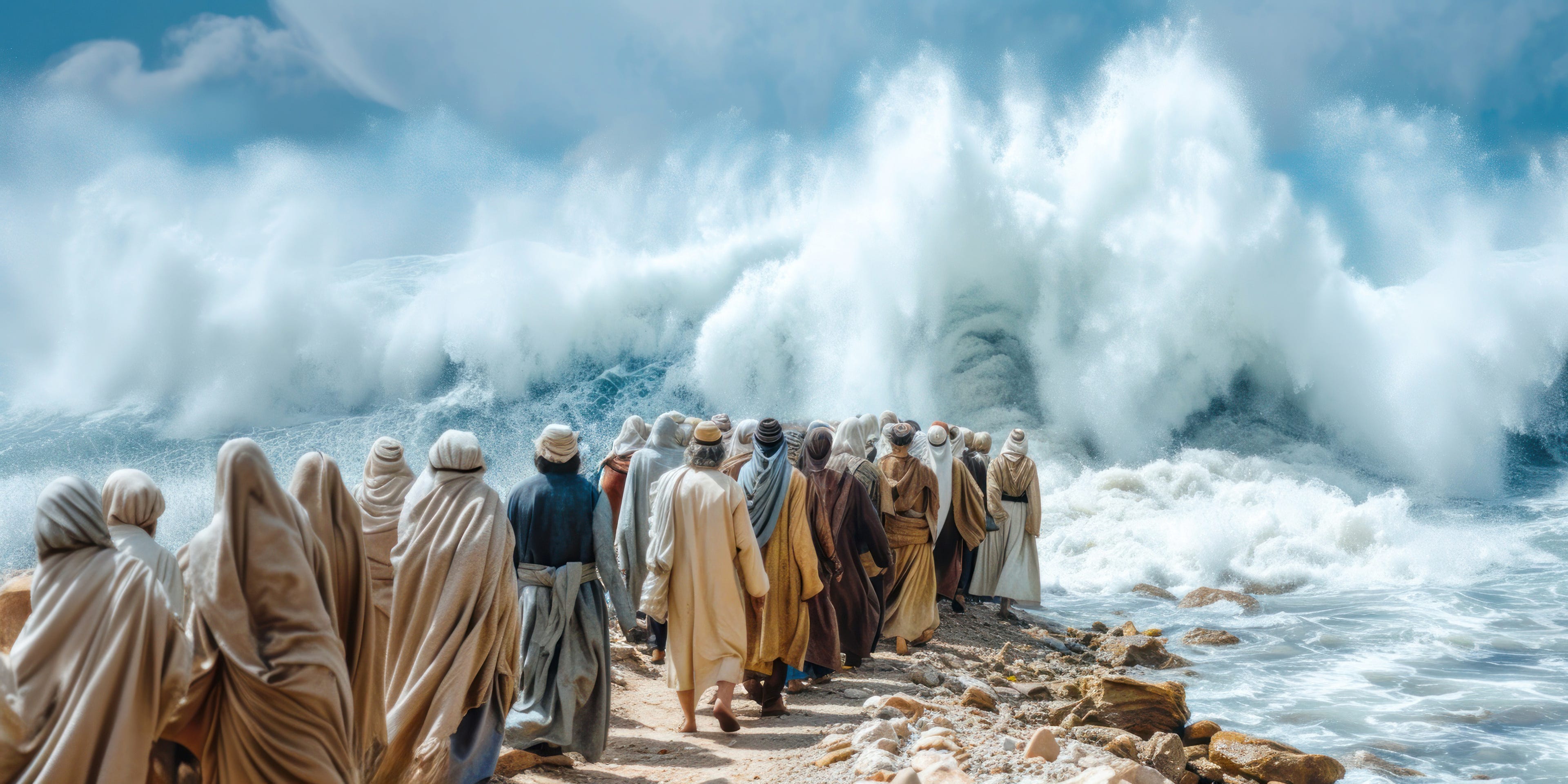
I want you to picture something. You’ve just walked out of the worst season of your life. The chains are finally off. The nightmare is behind you. You should feel free—and for a moment, you do. But then you look up, and there’s a wall of water in front of you. And behind you? The sound of hoofbeats. The thunder of chariot wheels. And everything in you starts to scream.
That’s exactly where Israel found itself in Exodus 14. Freshly delivered from four hundred years of slavery, and already staring at what looked like a dead end. The Red Sea ahead. Pharaoh’s army closing in from behind. No plan. No way out. Just fear, and a God they were still learning to trust.
Hold onto this as we walk through this text together: salvation is not the finish line. It’s the starting gun. God didn’t rescue His people so they could stand on the shore and wave goodbye to Egypt. He rescued them so He could shape them into something they’d never been before, a people who actually knew how to walk with Him.
God Acts When We’re Out of Options
Look at verses 10 through 12. The people saw Pharaoh’s army coming, and they panicked. And honestly? Who could blame them? This is the natural human response. They cried out, they complained, and they said something that I think cuts us deeper than we’d like to admit: “It would have been better to serve the Egyptians than to die here in the wilderness.”
Slavery was starting to look comfortable. Isn’t that something? When fear gets loud enough, even chains can start to feel like security.
But notice what Moses says to them in verse 13. He doesn’t panic. He doesn’t make a plan. He says, “Don’t be afraid. Stand firm and see the Lord’s salvation that He will accomplish for you today.” Stand firm. That’s it. No battle strategy. No escape route. Just trust. Because God was about to do something that no amount of human effort could pull off.
Paul says it like this in Romans 5:6: ”while we were still powerless, Christ died for us.” That word powerless is the key. God doesn’t wait for us to get ourselves together before He acts. He moves precisely when we’ve run out of moves. The moment of helplessness is not the moment God disappears. It’s usually the moment He shows up. This is something we might call the Red Sea principle. God’s power is made perfect in weakness. Not after weakness. In it.
Faith Is Not a Feeling. It’s a Movement.
Here’s where it gets really interesting. Verse 15. God has already told the people He’s going to fight for them, and then He says something surprising. “Tell the Israelites to break camp.” Move. Start walking. The water hasn’t parted yet. There’s no visible path. But God says go anyway.
See, God doesn’t always remove fear before He calls you to act. That’s a hard truth, but it’s a biblical one. He asked Israel to step toward the sea before He opened it. He called Moses to stretch out that staff before anything changed. Faith, in this moment, was not a warm feeling in their chest. It was wet sand between their toes.
Paul says we walk by faith and not by sight (2 Corinthians 5:7). That’s not poetry—it’s a description of what walking with God actually looks like most of the time. You move before you see. You obey before you understand. And later, Paul uses the language of baptism to describe this same kind of crossing: buried with Christ, raised to walk in newness of life (Romans 6:4). The Red Sea crossing and baptism are talking about the same kind of moment. A decisive break from the old. A step into something new. A death of the former self and the beginning of a redeemed one.
And notice, they crossed together. Every last one of them. Nobody got a private crossing. No one was saved alone. God forms His people together. That’s not an accident. Faith was always meant to be shared.
Deliverance Creates a People, Not Just a Crowd
Verse 31 is one of my favorite verses in this whole chapter. “When Israel saw the great power that the Lord used against the Egyptians, the people feared the Lord and believed in Him and in His servant Moses.” Did you catch that? Deliverance produced reverence. Salvation shaped belief. And belief started binding the people together.
Before this moment, they were a collection of former slaves. Different families, different histories, different levels of faith. But now, standing on the far shore, water at their backs, enemy defeated, they were something new. A redeemed people with a shared story, a shared God, and a shared future.
Paul tells the Ephesians that in Christ, God makes both Jew and Gentile into one body, tearing down every wall that once divided them (Ephesians 2:14-16). The cross does what the Red Sea did, it creates a new people out of formerly separate ones. And he reminds the Corinthians that all Israel was “baptized into Moses in the cloud and in the sea” (1 Corinthians 10:2). Collective deliverance. Collective identity. One crossing, one people.
That’s what the church is supposed to be. Not a gathering of individuals doing their own spiritual thing, but a redeemed body shaped by the same grace, walking toward the same future. We are no longer defined by our past, our failures, or our differences. We’re defined by the God who brought us out.
The Shore Is Not the Destination
Here’s the part that I think we miss. Exodus 14 ends in triumph. They’re safe. They’re free. The danger is gone. But Exodus 15 and beyond are coming, and they come fast. Hunger. Thirst. Bitterness at Marah. Grumbling about manna. The golden calf. The wilderness doesn’t stop just because the Red Sea is behind you.
God never promised that salvation ends the struggle. He promised something better: that He’d be in it with you. The miracle at the sea didn’t remove future challenges. It prepared them to face those challenges with God at the center.
Paul says it directly in Ephesians 2:8-10, God saves us by grace and then calls us to walk in the good works He prepared for us beforehand. Redemption leads to transformation. Freedom leads to growth. God doesn’t rescue His people to leave them unchanged. He rescues them to shape them.
And Hebrews 3 is sobering. The author looks back at Israel’s wilderness experience and says don’t do what they did. T” They were redeemed, but many of them failed to trust God fully along the way. Their story is both a warning and an invitation. Don’t harden your heart. Don’t mistake the beginning for the end.
What Does This Mean for You?
Maybe you’re standing at a Red Sea right now. Something’s in front of you that looks impossible. Something’s behind you that you thought you escaped. And the fear is loud. If that’s you, hear Moses again: “Stand firm and see the Lord’s salvation.” Don’t run back to Egypt. Don’t manufacture your own way through. Trust the God who has already proven He fights for His people.
Or maybe you’re on the far shore. You made it through something hard, and now life is relatively calm. Don’t think the journey is over. The wilderness is still ahead, and it’s in the wilderness that God does some of His deepest forming. Don’t stand still. Break camp. Keep walking.
And for all of us, remember that you didn’t cross alone. The person sitting next to you in worship? They crossed too. Different water, same God, same grace. We’re a redeemed people. That means we walk together, we carry each other, and we don’t leave anyone standing on the wrong shore.
Redemption is the beginning. Not the end. And the God who met Israel in the wilderness is the same God who meets His people today, faithful in every season, and always working to shape us for life with Him.
“The Lord will fight for you, and you must be quiet.” — Exodus 14:14

Thank you for sharing this message. It is encouraging to read reflections that remind believers that a true Christian voice must always point people back to Christ and the truth of Scripture. In a world filled with many competing voices the follower of Christ is called to speak with wisdom humility and courage. The Bible reminds us in 1 Peter 4:11 that if anyone speaks they should do so as one who speaks the very words of God. This shows that our words should reflect God’s truth and not simply our own opinions. A Christian voice is not only about speaking loudly but about living faithfully. Jesus taught in Matthew 5:16 Let your light shine before others so that they may see your good works and glorify your Father in heaven. When our lives reflect Christ our words carry greater meaning and influence. Scripture also reminds us in Colossians 4:6 Let your speech always be with grace seasoned with salt so that you may know how you ought to answer each person. A believer’s voice should be filled with grace truth and wisdom so that it builds others up rather than tearing them down. At the same time believers are called to remain faithful even when truth is unpopular. 2 Timothy 4:2 encourages us to preach the word be ready in season and out of season reprove rebuke and exhort with patience and teaching. The voice of a Christian should never be guided by the changing opinions of the world but by the unchanging Word of God. The Bible also reminds us in Proverbs 31:8 Open your mouth for the speechless and for the rights of all who are destitute. A faithful Christian voice speaks not only about faith but also about justice mercy and compassion for others. When believers speak with love truth and humility they reflect the heart of Christ to the world. May the Lord help us use our voices wisely so that our words bring encouragement truth and hope to others. Ephesians 4:29 reminds us Let no corrupt word proceed out of your mouth but what is good for edification that it may give grace to those who hear. May our voices always honor Christ and lead others closer to Him. Blessings. 🙏