



The picture James paints of a fighting church is not flattering.
His intention was to heal. All the articles in this series up to now have been about what’s wrong. This one is about what to plant instead. James stops naming the disease and hands us the seed.
And notice where he reaches for it. The remedy isn’t buried at the end of the letter in some tidy closing paragraph. It sits right in the middle of chapter three, tucked in immediately after the tongue and just before the question, “What is the source of wars and fights among you?” (James 4:1).
The cure is right next to the sickness. The same chapter that exposes the fire also shows you how to grow a garden. That’s not an accident. He wants you to see that peace is not merely the absence of the fight. It’s a crop you cultivate on the very ground the fight burned over.
Two Wisdoms, Two Harvests
James sees the remedy as a choice between two kinds of wisdom. Now, we don’t usually think of conflict as a wisdom problem. We think of it as a personality clash, a communication breakdown, or a difference of opinion. James goes deeper. He says that behind every way of handling a disagreement lies a wisdom, a whole approach to life, and that there are, in the end, only two of them on offer. One comes up from below. One comes down from above. But beware: both of them look like wisdom. Neither one announces itself as foolishness. The earthly kind feels shrewd, realistic, and strong. It’s only when you watch what each one grows that you can tell them apart.
Lay them side by side the way James does across verses 14 through 18.
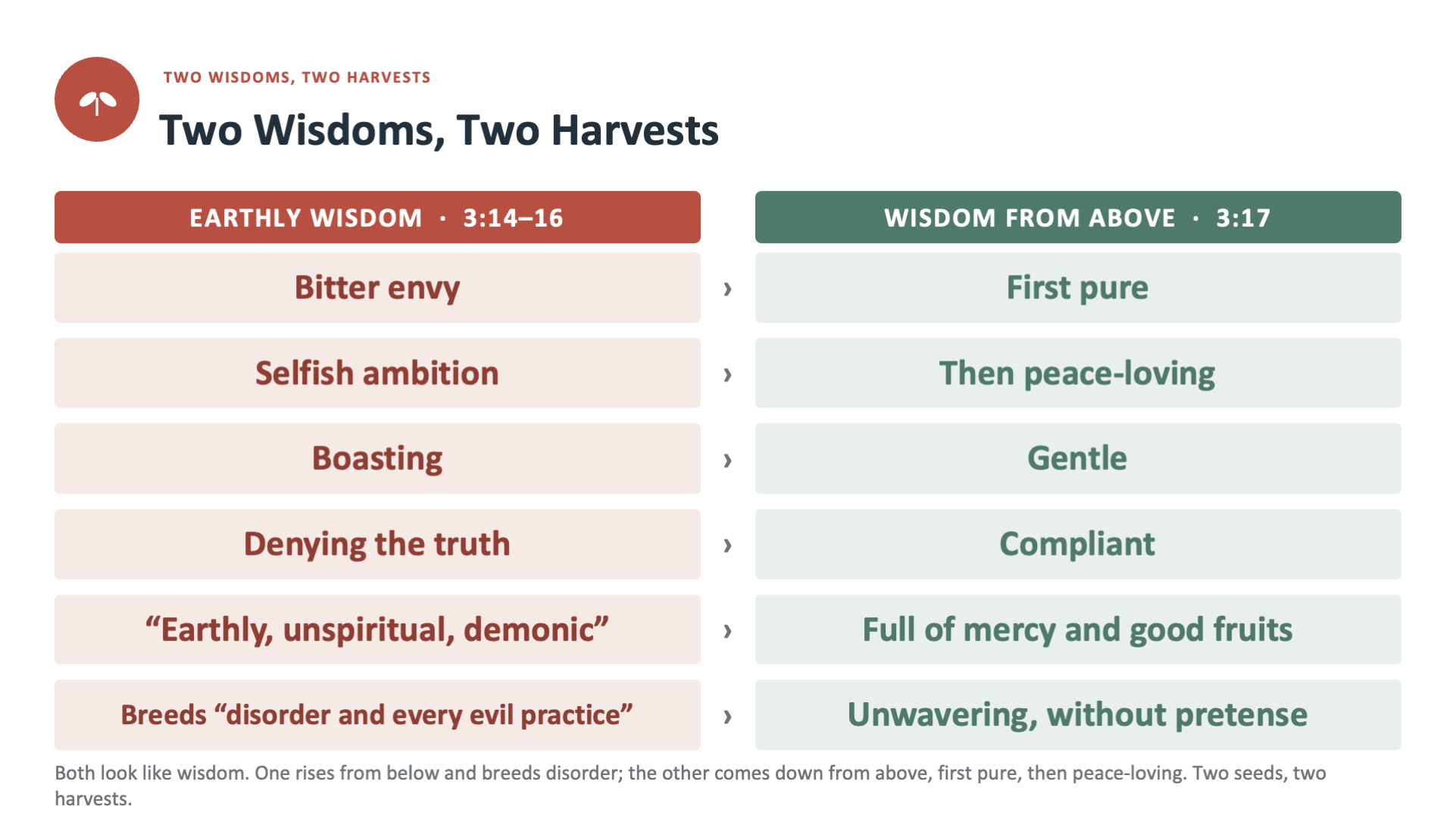
Read the left column, and you’re reading the anatomy of every church fight you’ve ever watched. It starts with a feeling, “bitter envy,” something curdling in the heart when a brother gets what you wanted. It grows an agenda, “selfish ambition,” the quiet campaign to come out on top. It protects itself with “boasting” and by “denying the truth,” because pride cannot afford to be wrong. James refuses to be polite about where that wisdom comes from. He stacks three words on it: “earthly, unspiritual, demonic” (3:15). Earthly wisdom shares an address with the pit. And its harvest is exactly what you’d expect from that soil: “disorder and every evil practice” (3:16). Plant that seed and you don’t get one problem, you get a field of them.
Now read the right side, and notice that James doesn’t lead with peace. He leads with purity. The very first quality of heavenly wisdom is that it’s “first pure.” Now, look at the rest of the list and see how gentle it all is. Peace-loving. Gentle. Compliant, which means willing to yield, or easy to be entreated. Full of mercy. Full of good fruits. Unwavering. Without pretense, which means no mask, no performance, no angle. That’s not a description of a weak person. It’s a description of a person who has nothing left to protect, and so has nothing left to fight for.
First Pure, Then Peace-Loving
The word order is important because it’s where many well-meaning Christians get peace wrong. Heavenly wisdom is “first pure, then peace-loving” (3:17). Purity comes first. Peace comes second. James put them in that sequence on purpose, and the sequence guards against two opposite mistakes people make when they try to be peacemakers.
The first mistake is to grab peace by sacrificing purity. This is the person who will say anything, agree to anything, paper over anything, just to make the tension stop. He calls it peace, but it isn’t. It’s avoidance wearing peace’s coat. He hasn’t grown a crop; he’s just mowed the weeds down to where you can’t see them, and they’ll be back taller next month. Peace that costs you the truth isn’t the wisdom from above, because that wisdom is pure before it’s ever peaceable. It will not buy quiet with compromise.
The second mistake runs the other direction: to defend purity so fiercely that you never get to peace at all. This is the person who is technically right and relationally impossible, who wins every doctrinal point and loses every brother, who mistakes his own sharp edges for a stand for truth. James blocks that road too. Yes, purity comes first, but it does not come alone. The very next word is “then peace-loving,” and after it comes a whole run of soft words: gentle, compliant, full of mercy. Real purity doesn’t stay hard. Once it’s established, it bends toward peace fast. The person who is pure but not peaceable has only done half of what James asked, and it’s the more dangerous half, because it feels so righteous.
Put them together, and you get the shape of a true peacemaker. He’s pure first, so he never sells out the truth to keep the quiet. But he’s peace-loving right after, so he never uses the truth as a club. He holds his convictions and holds out his hand at the same time. That’s not a contradiction. That’s the wisdom from above.
Peace Is Sown, Not Seized
Verse 18 says: “the fruit of righteousness is sown in peace by those who cultivate peace.” Every image in that sentence is agricultural. Sown. Fruit. Cultivate. James has deliberately left the courtroom and the battlefield and walked us out to a field, because he wants to change the way we picture peace altogether.
We tend to think of peace as something you win. You settle the argument, you reach the agreement, you shake hands, and there, it’s done, peace achieved in an afternoon. James says no. Peace isn’t seized like a victory; it’s sown like a seed. And everybody who has ever planted anything knows what that means. You don’t harvest the day you plant. You put the seed in the ground, and then you wait, and you water, and you pull weeds, and you wait some more. Peacemaking is slow, patient, unglamorous ground-work. It’s the hundredth kind word after the argument, not the one dramatic reconciliation scene. The person James blesses isn’t the one who wins the peace; it’s the one who “cultivates” it, day after day, in the long ordinary seasons between the fights.
And look at what grows from that seed: “the fruit of righteousness.” That’s the payoff, and it’s a pointed one, because James already told us what can’t produce it. Back in chapter one he said, “human anger does not accomplish God’s righteousness” (1:20). Anger has never once grown righteousness. It promises to. It tells you that if you just come down hard enough, get angry enough, fight fierce enough, you’ll finally set things right. It’s lying. Anger is a barren field. It can scorch, it can clear ground, but it cannot grow the one crop you actually want. Only peace grows righteousness, and only the patient peacemaker gets the harvest.
The Goal Was Never Winning. It Was Restoring.
If peace is a crop, we should ask what it’s finally for. What’s the harvest actually meant to feed? In chapter 5, we find two closing pictures, and neither one looks like a truce. They both look like a rescue.
Confession and healing (5:16). “Confess your sins to one another and pray for one another, so that you may be healed” (5:16). Stop and feel how vulnerable that is. James isn’t describing a congregation that has simply stopped fighting. A cold war can produce that. He’s describing something far braver: a family where people actually open up the wound and name it out loud to each other, and then pray each other back to health. That’s the opposite of a church fight, where the whole game is to hide your own faults and expose everyone else’s. Real peace isn’t the absence of friction. It’s the presence of enough trust that a brother can say “here’s where I’ve failed” and find prayer instead of ammunition. That healing is what the seed was for.
Restoring the wanderer (5:19-20). And then the very last words of the letter: “if any among you strays from the truth, and someone turns him back, let that person know that whoever turns a sinner from the error of his way will save his soul from death and cover a multitude of sins” (5:19-20). Look where James chose to end. Not on a doctrine, but on a picture of one brother or sister going after another who has wandered off, and bringing him home. The book that spent so much energy exposing conflict closes on a rescue mission. The final image in James isn’t a courtroom. It’s a search party.
Set those two endings against everything the letter warned about, and the contrast could not be sharper. Earthly wisdom wants to be proved right. Heavenly wisdom wants the brother back. The proud man in a conflict is asking, “How do I win this?” The peacemaker is asking, “How do I save him?” One of those questions comes up from below. The other comes down from above.
Tie to the Sermon on the Mount
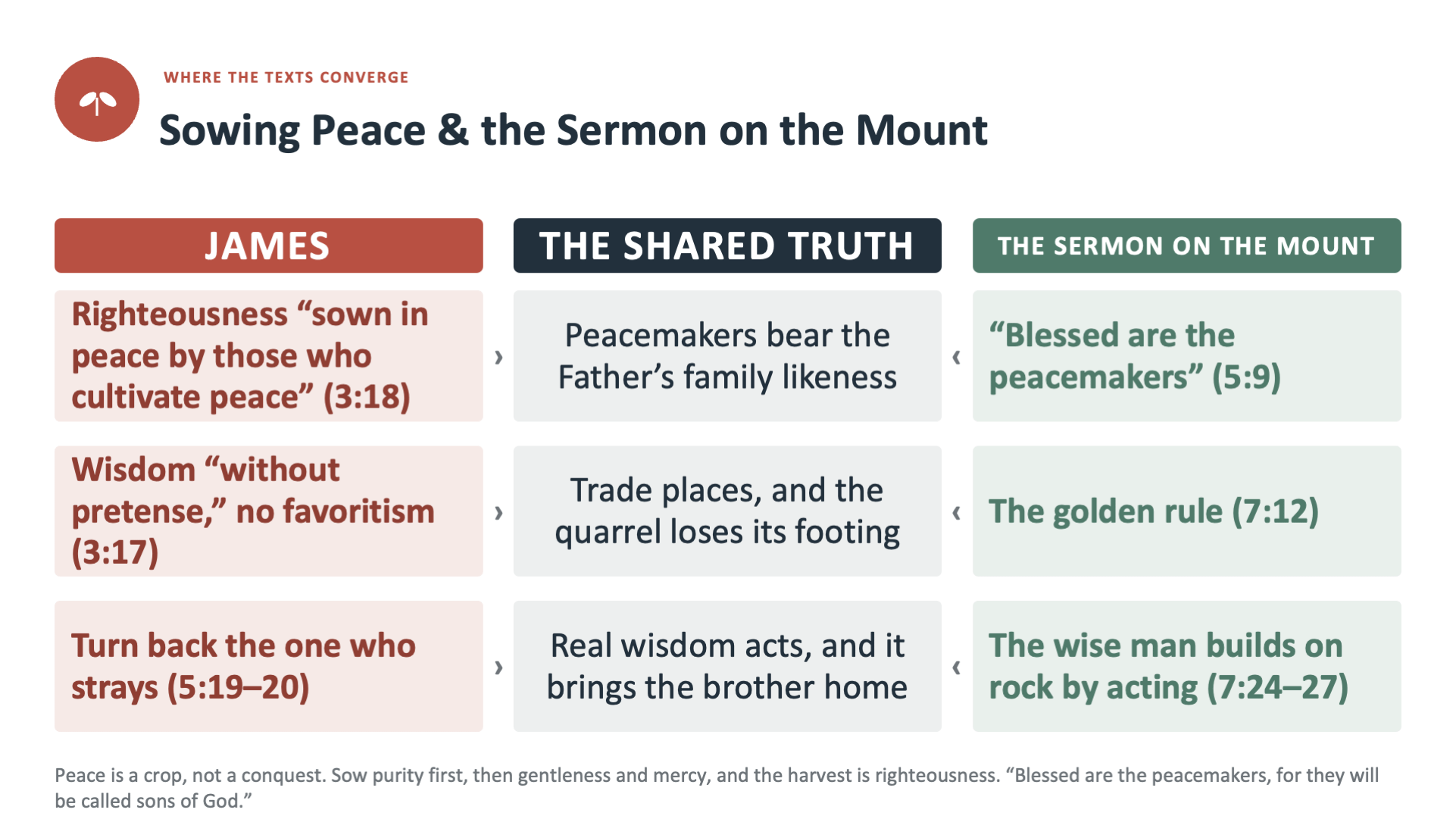
James is preaching his brother’s sermon one final time, and it’s unmistakable here. Verse 18 is the seventh Beatitude set to music: “Blessed are the peacemakers, for they will be called sons of God” (Matt 5:9). Of all the titles Jesus could have hung on the peacemaker, He chose the family name. Sons of God. Why that one? Because peacemaking is the family business. It’s what the Father has been doing since the fall, reconciling the world to Himself, and a child looks most like his Father when he’s doing the Father’s work. You never resemble God more than when you’re standing between two estranged people helping them come back together. James says that peacemaker is sowing for a harvest of righteousness. Jesus says he’s earning a family resemblance. Same person, same work, seen from two angles.
The golden rule belongs here too, because it’s the seed reduced to one sentence. “Whatever you want others to do for you, do also the same for them” (Matt 7:12). Nearly every conflict we’ve studied dies right there if we’ll apply it. Partiality can’t survive it, because you’d never seat yourself on the floor. Judging can’t survive it, because you’d want mercy, not a verdict. Pride can’t survive it, because you’d want to be heard, not steamrolled. The golden rule is peacemaking boiled down to a reflex: before you act, trade places. Ask what you’d want if you were the brother across the table, and then go do that. Most quarrels never get started in a room full of people running that one calculation.
I think James clearly built his epistle to land the same way Jesus landed the sermon. Jesus closes with two builders. “Everyone who hears these words of mine and acts on them will be like a wise man who built his house on the rock” (Matt 7:24). Not the one who hears. The one who hears and acts. James said the identical thing in his first chapter: “be doers of the word and not hearers only, deceiving yourselves” (1:22). And that’s the warning to carry out here. We can work through teaching on conflict, nod at every chart, underline every verse, and change absolutely nothing when the next disagreement flares up. Hearing built no house. The wise builder is the one who dug down, laid the seed, and followed through.
Peacemaking Is Not Peacekeeping
It would be easy to walk away right here and come up with a soft and slightly wrong idea of peace, so it’s worth drawing one line the series closes. There’s a difference between a peacemaker and a peacekeeper, and James is only asking us to be one of them.
A peacekeeper manages tension. He keeps things quiet. He steps between people not to heal anything but to make the noise stop, and he’ll trade almost anything for calm, including the truth. His peace is fragile because it’s built on avoidance, and everyone in the room can feel the pressure underneath it. Nothing has been sown. The weeds have just been asked to keep their voices down. That’s the counterfeit, and it fails the very first test of heavenly wisdom, because it isn’t “first pure.” It skipped straight to a nervous, negotiated quiet and called it peace.
A peacemaker does something harder and braver. He actually makes peace where there wasn’t any, which means he’s willing to walk into the tension rather than tiptoe around it. He’ll name the sin, his own included, because he knows healing needs an honest wound. He’ll pursue the wanderer instead of letting him drift, because the goal was always restoration and not just an absence of conflict. Peacekeeping is passive and protects itself. Peacemaking is active and spends itself. One wants the trouble to be over. The other wants the brother to be well. James blesses the second one and hands the Father’s name to him alone.
So when you want to be a peacemaker, you aren’t being asked to become the person who smooths everything over and never says the hard thing. That person is exhausting the truth to buy a quiet that won’t last. However, you are being asked to become the far rarer person who is pure enough to tell the truth and gentle enough to be heard, who plants patiently and pursues faithfully, who would rather lose the argument than lose the brother.
Bringing It Home
So, it all comes down to a choice of seed. You are always planting something in your relationships, in your congregation, in the aftermath of every disagreement. The only question is what.
You can sow strife. The seed is easy to get, because it’s already in your pocket: the envy that resents a brother’s blessing, the sharp word fired back in the moment, the quiet verdict passed from the bench, the pride that has to be right. Plant that, and it comes up fast, and the harvest James promises is “disorder and every evil practice” (3:16). Nobody has to teach a church how to grow that crop. It grows itself.
Or you can sow peace. That seed costs more and grows slower. It’s pure first, so it won’t lie to keep things comfortable, and it’s peace-loving right after, so it won’t wound to prove a point. It’s gentle, merciful, patient, and it plays the long season, because peace is cultivated and not seized. And the harvest, when it finally comes in, is the one crop anger could never grow: “the fruit of righteousness,” a healed and honest people who confess to one another, pray for one another, and go out after the ones who wander. That harvest has the Father’s name written on it, because “blessed are the peacemakers, for they will be called sons of God.”
So go be a peacemaker. Not a peacekeeper who buys a nervous quiet, but a peacemaker who plants the real thing and waits for it to grow. The whole point was never to win the argument. It was to bring the brother home. Now the only thing left is to be a doer of it, and not a hearer only.

So very well written, so very well thought out and delivered. Is any of all of this available to be shared in a sermon without violating copyright or infringements of any kind?