


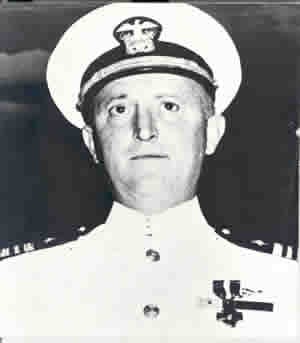
Last Friday, a post1 about the heroism and ultimate sacrifice of Submarine Commander Howard Gilmore came across my X feed from @HiddenHistoryYT. It was the first time I'd heard about his selflessness.
On the night of February 7, 1943, the submarine USS Growler ran on the surface in the dark of the southwest Pacific, stalking a Japanese convoy. Commander Howard Gilmore stood on the bridge. Then an enemy escort spotted her and swung around to ram, charging straight out of the black.
Gilmore reacted in a heartbeat. He ordered a hard turn to strike first, and the Growler slammed into the enemy ship at speed. The collision bent eighteen feet of the submarine’s bow sideways. At that same instant the Japanese crew raked the exposed bridge with machine gun fire. Two of Gilmore’s men died where they stood. The commander went down, badly wounded, on his own bridge.
Now understand the situation. A submarine’s bridge is a small platform on top of the conning tower. To dive, the crew drops through a hatch into the hull and seals it behind them. The wounded men who could still move went down. Gilmore could not. His injuries made it impossible for him to move.
He did the arithmetic in seconds. The boat was on the surface. She was exposed. She was being shot at. Every second she stayed up, she might go down with every man aboard. The only way to save her was to dive right then. You cannot dive with the hatch open. And he could not reach the hatch.
So he gave the order. Clinging to the bridge, bleeding, he called down into the hull: Take her down.
His officers froze at the horror. Then they obeyed their captain. They sealed the hatch and took the Growler under while he was still on top of her. Howard Gilmore was never seen again. The battered boat limped home. He became the first submariner of the war to wear the Medal of Honor, and his last order still stands in the Submarine Force as the highest thing a commander can say. Every man on that crew who survived lived the rest of his life because of his fearless and courageous decision.
There is a Greater Story
Gilmore had seconds to decide. Jesus had eternity.
Adopt the same attitude as that of Christ Jesus, who, existing in the form of God, did not consider equality with God as something to be exploited. Instead he emptied himself by assuming the form of a servant, taking on the likeness of humanity. And when he had come as a man, he humbled himself by becoming obedient to the point of death—even to death on a cross, Philippians 2.5-8.
Walk down that stair-step with Jesus again. Existing in the form of God. That is where he began. Emptied himself. The form of a servant. Obedient to the point of death. Even to death on a cross. Every step goes lower. Down from glory. Down into flesh. Down to a servant’s place. Down to a grave. Down to the ugliest death Rome could invent.
Here is what makes it greater. Gilmore was already dying when he gave his order. He was shot, and there was no coming back. Jesus was not. Nothing had touched him. No wound, no failing strength, no enemy fire. He looked down from heaven, saw a boat going under with all hands, and came down anyway. No one takes it from me, but I lay it down on my own, John 10.18.
And what was the crew he came for? Gilmore saved eighty sailors who had served under him faithfully. Jesus died for people who had run the other way. But God proves his own love for us in that while we were still sinners, Christ died for us, Romans 5.8. We were not the loyal crew. We were the ship charging out of the dark.
Have you ever wondered why Paul tells this? We need to remember what comes just before: Do nothing out of selfish ambition or conceit, but in humility consider others as more important than yourselves, Philippians 2.3. Paul is writing to a church that appears to have a unity problem, and ultimately two women in it who could not get along, Philippians 4.2.
That is the hard part for us. We are not only saved by the cross, but we are also shaped by it. Adopt the same attitude.
So what does that look like on this Monday morning?
Most of us will never be asked to die for anybody. That is not where this gets tested. It gets tested in a kitchen at ten o’clock at night, when you are right, your spouse is worn out, and you have three more sentences ready to prove your point. It gets tested when the credit for your work lands on somebody else’s desk and no one notices. It gets tested in a meeting at the church building, when the plan everyone likes is not the plan you brought in. It gets tested when a relationship between you and a brother or sister goes sideways, and you must decide whether you’ll take the first step in pursuing peace … even when you don’t feel like it.
Understand what humility is and is not. It is not weakness. It is not losing. Gilmore did not lose his life on that bridge. He spent it. There is a world of difference between a man who gets run over and a man who lays himself down. One is a victim. The other is a captain.
And notice the direction of it. Jesus did not empty himself of who he was. He emptied himself of what he was owed. That is the step most of us will not take. We will give away our time. We will give away our money. We will not give away our rights.
What about you? Who in your life needs you to go down one step so they can come up one? When did you last surrender something you had every right to keep? Are you keeping score in your marriage? Do you insist on your seat, your say, your credit, your turn to be heard? Will you take the first step in restoring peace to a damaged relationship? How much of your week goes to guarding a position Christ would have emptied?
Gilmore gave the order because he could not reach the hatch. Christ gave it, though he could. He had every right to climb down. He stayed on the bridge.
Take her down. He meant himself.


Thank you for sharing this, brother. I may not be able to see the full article from the link, but the title itself points toward a difficult and meaningful subject. Whatever we are facing, Scripture reminds us that our battle is ultimately not against people but against spiritual forces, and we are called to respond with truth, prayer, and love. Ephesians 6:12 says, For our struggle is not against flesh and blood, but against the rulers, against the authorities, against the powers of this dark world. Jesus also taught us to love our enemies and pray for those who persecute us (Matthew 5:44). May we never allow anger, hatred, or bitterness to take control of our hearts, but instead stand firmly in Christ and allow His truth to guide us. Ephesians 4:15 calls us to speak the truth in love, and Romans 12:21 reminds us, Do not be overcome by evil, but overcome evil with good. May the Lord give us wisdom, courage, and humility to stand for what is right while keeping the heart of Christ toward everyone. 🙏❤️