


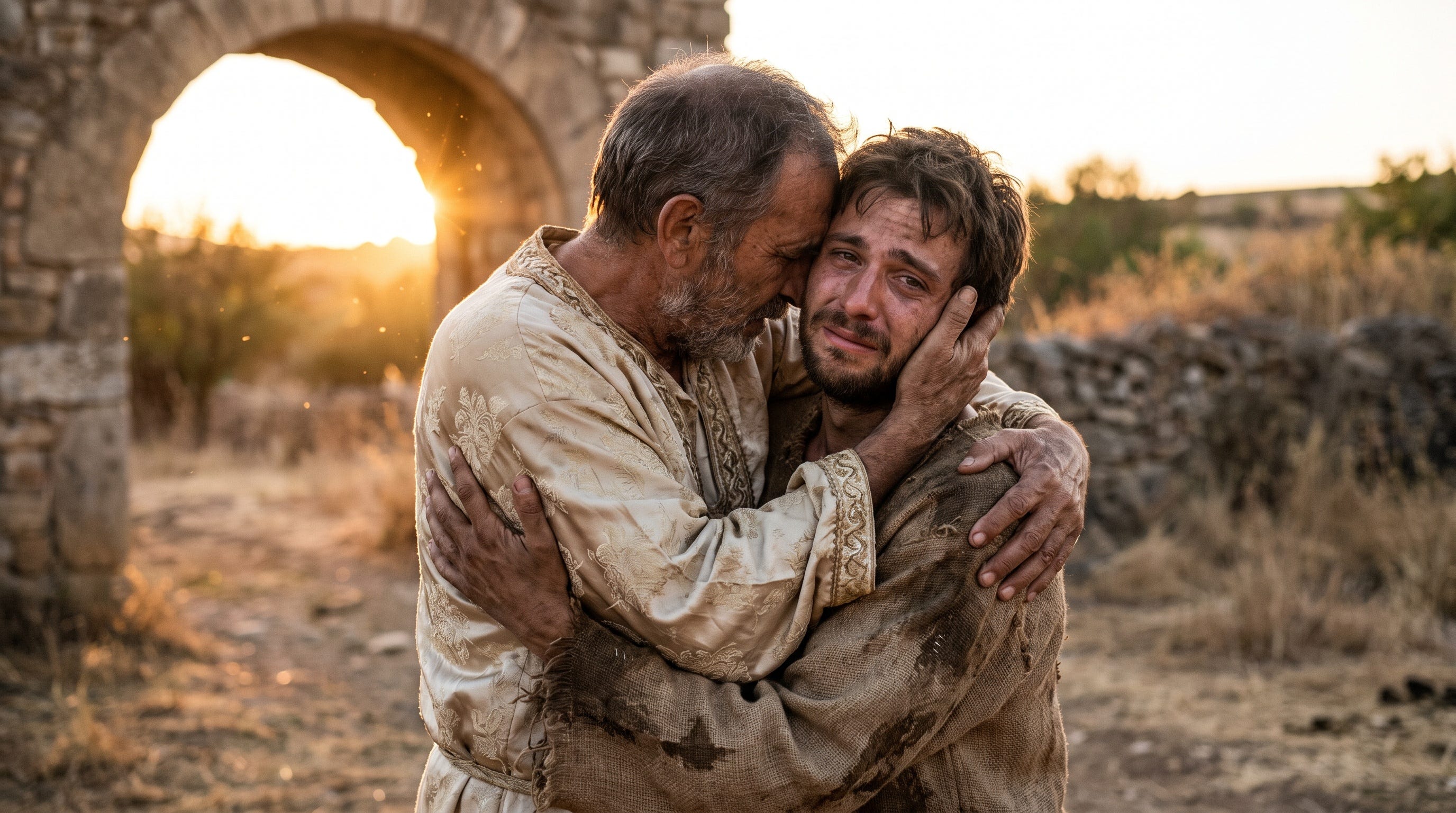
But while the son was still a long way off, his father saw him and was filled with compassion. He ran, threw his arms around his neck, and kissed him. Luke 15:20
Have you ever rehearsed an apology? I did it as a boy, walking down the hall to go find Mom or Dad. I still do it, only now in my truck. Maybe you’ve worked out what to tell the boss, or the neighbor whose mailbox you backed into, and given the speech four times before you ever pull into the driveway.
We rehearse because we don’t know how we’ll be received. The speech protects us, and we usually build in an explanation we hope will take some of the sting out of the apology.
Yesterday I mentioned a story Jesus told about two sons who both thought their father was an employer. Today I want to stay with the younger one, the boy who rehearsed a speech all the way home, and the father who wouldn’t let him finish it. His older brother is still out in the field. We’ll come back for him.
Why Jesus Told It
Luke 15 opens with two crowds. All the tax collectors and sinners were approaching to listen to him. And the Pharisees and scribes were complaining, “This man welcomes sinners and eats with them,” Luke 15:1–2. In that world, if you sat down at someone’s table, you were saying you accepted them. The religious leaders couldn’t understand how a teacher from God could sit down to supper with people like that.
Jesus answered them with three stories. In the first, a shepherd loses one sheep out of a hundred, and in the second a woman loses one coin out of ten. The third begins, A man had two sons.
A Speech in the Pigpen
The younger son asks for his share of the estate now. Under the law the older son received a double portion (Deuteronomy 21:17), so this boy stood to get a third. An inheritance came when your father died. Asking for it early was about as close as you could come to telling your father you wished he were already dead. And the father gave it to him.
Not many days later, he turned it into cash, went as far from home as he could get, and squandered his estate in foolish living, Luke 15:13. Then the money ran out, a famine hit, and he ended up feeding pigs for a foreigner. For a Jewish audience you couldn’t sink any lower. He was jealous of what was in the pigs’ trough, and no one would give him anything.
Then … he came to his senses, he said, “How many of my father’s hired workers have more than enough food, and here I am dying of hunger!” Luke 15:17. What brought him to his senses was his stomach. You and I have probably watched God use an empty stomach to bring plenty of people home. He doesn’t wait for your motives to be pure before he starts drawing you back.
So he writes his speech. Father, I have sinned against heaven and in your sight. I’m no longer worthy to be called your son. Make me like one of your hired workers, Luke 15:18–19. The confession is a good one, but the last line is a job application. A hired worker didn’t live in the house. He was paid by the day, and his place was only as good as his last week’s work. The son figures he can’t be family anymore, but maybe he can earn a wage, work off what he owes, and eat on the porch.
Maybe you’ve come back to God with that same plan. I know I can’t be what I was. Just let me work my way back into good standing.
A Long Way Off
Now verse 20: So he got up and went to his father. But while the son was still a long way off, his father saw him and was filled with compassion. He ran, threw his arms around his neck, and kissed him.
You don’t spot somebody a long way off unless you’ve been looking. That father had been watching the road. How many evenings had he stood at the edge of his land, looking down it?
Filled with compassion comes from a word built on the Greek for a person’s insides. It’s compassion you feel in your gut. Luke uses it for Jesus at the funeral in Nain, when he saw a widow burying her only son (Luke 7:13), and for the Samaritan who stopped on the Jericho road (Luke 10:33).
Then he ran. A man of his age and standing didn’t run. To do it, he’d have to hike up his robes and show his legs in front of the whole village, and nobody with any dignity did that. He may have had another reason to hurry, too. A boy who’d shamed his family like that wasn’t going to get a warm welcome walking through town. The father reaches him out on the road before the village does. Whatever shame gets handed out that day, the father takes it on himself.
He throws his arms around his son and kisses him before the boy has gotten a single word of his speech out.
The Speech He Never Finished
Now lay verse 21 next to verse 19 and see what’s missing. Father, I have sinned against heaven and in your sight. I’m no longer worthy to be called your son. He gets the confession out. He never gets to make me like one of your hired workers.
But the father told his servants, “Quick! Bring out the best robe and put it on him; put a ring on his finger and sandals on his feet,” Luke 15:22.
Every gift says son. The best robe in the house, very likely the father’s own, covers the rags and the smell of the pigs, and anyone who sees that boy walk through the village now knows his father’s taken him back. The ring is a signet that carries the family’s authority. When Pharaoh raised Joseph over Egypt, he took the signet ring off his own hand and put it on Joseph’s (Genesis 41:42). Nobody hands the family seal to a day laborer. The sandals matter too. Servants often went barefoot, and sons wore shoes. He’d walked home barefoot, and he went into the house with shoes on his feet.
Then comes the fattened calf, the one they’d been saving for a special day. Because this son of mine was dead and is alive again; he was lost and is found! Luke 15:24.
What did he do to earn any of it? He came home hungry, with mixed motives and a speech that was half wrong, and the father didn’t wait for any of that to improve before he started running.
The Father Who Ran All the Way
That father took some shame on himself on a dusty road so his son wouldn’t have to carry it through the village. Jesus took all of it. Instead he emptied himself by assuming the form of a servant, taking on the likeness of humanity. And when he had come as a man, he humbled himself by becoming obedient to the point of death—even to death on a cross, Philippians 2:7–8. He came all the way to the far country where we were, and he bore the disgrace that belonged to us so we could come home as sons and daughters.
And remember who Jesus was talking to. The grumblers meant This man welcomes sinners and eats with them as an accusation. It turned out to be the best news in the chapter. They were watching the Father’s welcome happen right in front of them, at a table with Jesus.
You Don’t Need a Speech
Some of you know the far country, and you don’t need anyone to describe it to you. You might still be out there, wondering whether you’d even be welcome inside a church building after all these years. Or you’ve been a Christian a long time and wandered a long way, and now you’ve started the walk home. You’re rehearsing what you’ll say and figuring how long you’ll have to sit on the porch before God lets you back in the house.
You can put the speech away. The Father’s been watching the road, and in Jesus he’s already run to meet you.
Tomorrow we’ll go back to the first garden and ask a hard question. If the Father runs toward us, why do we keep running the other way?
MEMORY VERSE
But while the son was still a long way off, his father saw him and was filled with compassion. He ran, threw his arms around his neck, and kissed him.
Luke 15:20 (CSB)
Weekly Challenge
Write down the speech you’ve been rehearsing to God, the apology and the bargain you tacked onto the end of it. Pray the confession out loud. Then cross out the bargain. And if someone you love is in the far country, reach out to them this week with no lecture attached.

From Fear to Faith | fromfearto.faith