



What I originally intended as a five-article series has turned into more than that. I hope you’re enjoying this study. Last Friday’s article covered James 4:11-12, which left us standing in front of a mirror, having just climbed down off a bench we were never appointed to. We learned to stop passing verdicts on a brother because the seat of judgment is taken. But James’ writing doesn’t stop there, because he knows the verdict had a source. Nobody climbs onto God’s bench by accident. Something lifts a person up there, props him in the chair, and convinces him he belongs.
What is that?
It’s pride. The self-appointed judge was a proud man before he was a harsh one. The sharp tongue in James 3 is a proud heart finding its volume. The grasping desire inside us, the want that got told no and decided to take by force, is pride insisting the world owes it. Dig under any of the sins we’ve studied so far, and you hit the same bedrock. James has been all around it in the whole letter, and now he stops and points: “God resists the proud.”
So what we’ll consider today goes underneath. We’ve found the root, the weapon, and the verdict. Now we find what powers all three. If you only had time to fix one thing in a quarreling church, this would be it, because pride is the engine that drives the rest.
The Sin Under the Sins
Pride is the one sin that uses every other sin as a costume and never shows its own face. Envy looks like envy. Slander sounds like slander. But pride almost always presents as something respectable: conviction, standards, self-respect, principle. We rarely catch ourselves being proud. We catch ourselves being right.
James cuts through the disguise by quoting Scripture: “God resists the proud but gives grace to the humble” (4:6). He’s pulling from Proverbs 3:34, and he wants the full force of the Old Testament behind the claim. Look hard at it, because we read past it too fast. It doesn’t say God is disappointed by the proud, or saddened by them, or patient with them. It says He resists them. The word is military. It pictures God taking up a position against a person, lining up on the opposite side, actively opposing the proud man’s advance. The same God who pours out grace like a flood stands Himself like a wall against pride.
Let that reframe every church fight you’ve ever seen. When two proud people square off over the budget, the building, or the order of worship, they imagine the contest is between the two of them. It isn’t. Each of them has taken on a second opponent, and a far stronger one, because “God resists the proud” on both sides of the aisle at once. You can win the argument with your brother and still be standing on the field against God. There is no lonelier victory.
And notice the hinge the verse turns on: “But he gives greater grace.” Greater than what? Greater than the pull of the cravings James just described, greater than the world’s friendship he warned about in verse 4, greater than our stubborn capacity to fight. God’s grace outweighs all of it. But that grace has a single address. It goes to the humble. The proud man stands in a downpour of available grace holding an umbrella he made himself, and wonders why he’s still dry.
The Cure Is a Staircase Down
So what do you do with pride? Watch James’s prescription in 4:7-10, and watch the direction every step moves.
“Submit to God. Resist the devil, and he will flee from you. Draw near to God, and he will draw near to you. Cleanse your hands, sinners, and purify your hearts, you double-minded. Be miserable and mourn and weep... Humble yourselves before the Lord, and he will exalt you.”
Count the steps. Submit. Resist. Draw near. Cleanse. Purify. Mourn. Humble yourself. Every one of them goes down. There’s not a single rung that climbs. The whole staircase descends, and then the bottom step turns out to be the top one: “Humble yourselves before the Lord, and he will exalt you” (4:10). You don’t lift yourself. You lower yourself, and let God do the lifting.
This is the exact opposite of how the world resolves a conflict. The world’s counsel is to climb. Assert yourself. Stand your ground. Don’t let them push you around. Get the last word. Win. And every rung of that ladder is pride reaching higher. James turns the whole thing upside down. The way out of the quarrel isn’t up, it’s down, through submission and confession and mourning over the sin you’d rather defend. He even refuses to let us keep the cheerful face we wear to church. “Be miserable and mourn and weep” (4:9). Take your pride seriously enough to grieve it.
And here’s the promise that makes the descent bearable. The downward staircase doesn’t end in the basement. It ends in God’s hand. “He will exalt you.” The only lasting way up runs through the bottom. Every other route up is the one God has positioned Himself to resist.
Pride Wears Disguises
James doesn’t leave pride as an abstraction. Across the letter he catches it wearing three different outfits, and all three are conflict-makers. Learning to recognize the costumes is half the battle, because pride almost never walks in announcing itself.
Partiality (2:1-9). The first disguise is favoritism, and James spends most of a chapter on it. The wealthy visitor in fine clothes gets “Sit here in a good place,” and the poor man gets “Stand over there” or “Sit here on the floor by my footstool” (2:3). James doesn’t call that bad manners. He calls it being “judges with evil thoughts” (2:4), and says it breaks “the royal law,” love your neighbor as yourself (2:8). Strip the costume off and favoritism is just pride doing math, ranking people by what they can do for you, deciding in advance who’s worth your respect and who can sit on the floor. A church that sorts people that way is a church already cracking along the seam, and the crack runs straight back to pride.
Boasting about tomorrow (4:13-16). The second disguise is the most socially acceptable of all. “Today or tomorrow we will travel to such and such a city and spend a year there and do business and make a profit” (4:13). Nothing in that sentence sounds like sin. It sounds like ambition, planning, good stewardship. But James calls it out: “you do not know what tomorrow will bring” (4:14). And he presses the point: your life is “like vapor that appears for a little while, then vanishes” (4:14). Then the verdict: “you boast in your arrogance. All such boasting is evil” (4:16). Presuming on tomorrow is pride aimed at the calendar, treating God’s providence as your possession, talking about next year as though you held the deed to it. The cure is one short phrase James hands us in verse 15: “If the Lord wills, we will live and do this or that.”
Bitter envy and selfish ambition (3:14-16). The third disguise hides in the heart and only shows itself under pressure. James calls it “bitter envy and selfish ambition,” and refuses to dignify it: “don’t boast and deny the truth” (3:14). This kind of so-called wisdom is “earthly, unspiritual, demonic,” and wherever it sets up shop, “there is disorder and every evil practice” (3:15-16). Envy is pride that can’t stand to watch someone else get lifted up. The brother gets the appointment you wanted, the praise you earned, the role you’d already assigned yourself, and something curdles. That souring is pride, and James says it breeds disorder. Where comparison runs unchecked, the fuses are already laid.
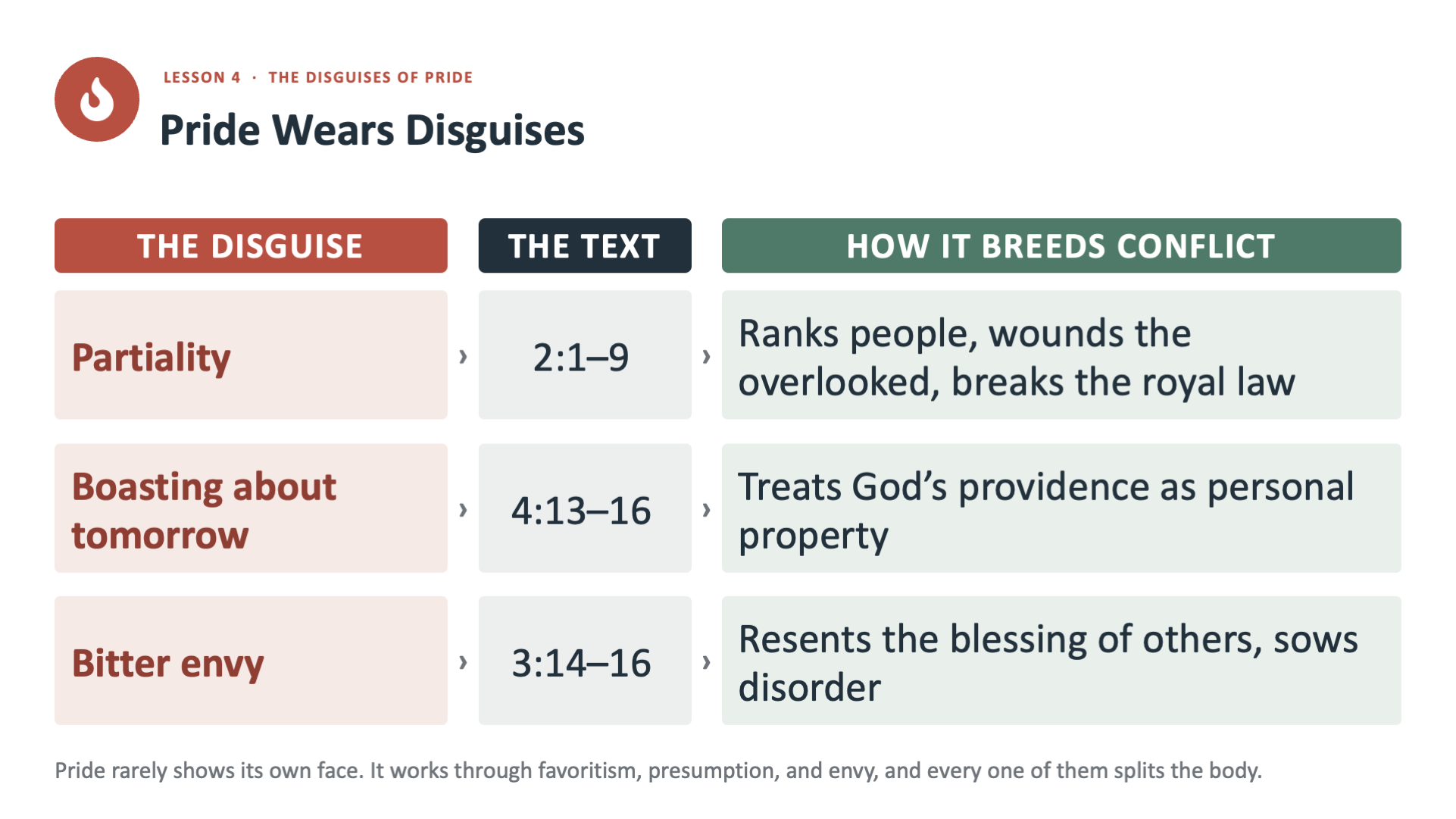
Notice the texts in that middle column. They’re scattered across the letter, chapters two, three, and four. James didn’t file pride under a single heading. He found it everywhere, because that is where it lives. The same root pushes up through the floorboards in a dozen different rooms.
Tie to the Sermon on the Mount
None of this is new with James. He’s preaching his brother’s sermon again, and the Sermon on the Mount opens on this exact note. The very first word out of Jesus’ mouth in the Beatitudes is about the lowly. “Blessed are the poor in spirit, for the kingdom of heaven is theirs” (Matt 5:3). Poor in spirit is the precise opposite of proud in spirit. It’s the person who has stopped pretending he brings anything to the transaction, who shows up empty-handed and knows it. Jesus puts that person at the very front of the line for the kingdom. And James says God “gives grace to the humble.” Same door, same key. The kingdom and the grace both open to the one who comes low.
Then Matthew 6 takes pride apart piece by piece, and it’s worth seeing how surgical Jesus is. Three times He warns against doing righteousness for an audience. Give to the needy in secret, “don’t sound a trumpet before you” (6:2-4). Pray behind a closed door, not “on the street corners to be seen by people” (6:5-6). Fast without the long, advertised face (6:16-18). Three acts of devotion, and three times the warning is identical: the moment you do it to be seen, you’ve traded God’s reward for the audience’s applause. Pride wants witnesses. It needs someone watching, or the performance has no point. Humility is content with God watching and no one else, and that one difference dismantles much of what keeps a church fight alive. We don’t hold the grudge for justice. We hold it for the gallery.
And the boasting about tomorrow runs straight into Matthew 6:34. James says you don’t even know whether you’ll see tomorrow. Jesus says, “don’t worry about tomorrow, because tomorrow will worry about itself” (Matt 6:34). Different angles, same target: the proud illusion that we’re holding the controls. James says don’t presume on tomorrow; Jesus says don’t fret over it. Both are prying our fingers off a steering wheel that was never ours, and both replace the anxious grip with trust in a Father who already holds the day.
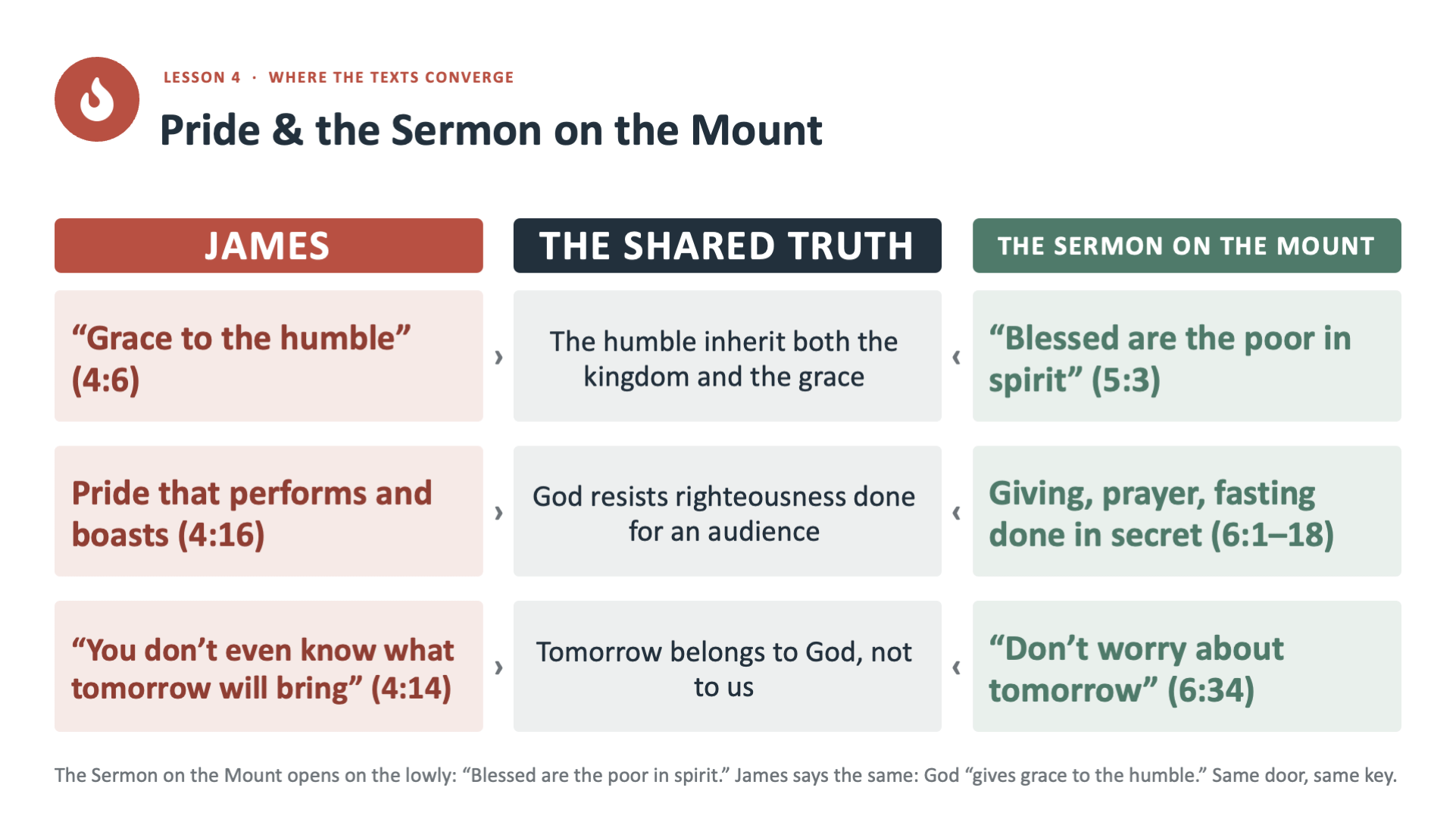
Stay on that first row a moment, because it carries the lesson. Jesus and James agree on a principle that runs backward from the world’s. The way up is down. The kingdom doesn’t go to the ones who earned a place at the front; it goes to the poor in spirit, the ones who know they have no claim. Grace works the same way. A full hand can’t receive it. You have to open the hand first, and opening it is the one thing pride will not do.
Two Crowns, One Throne
A simple side-by-side makes the matter plain. Pride and humility are not two moods or two temperaments. They are two answers to one question: who sits on the throne of your life? Almost every congregational conflict is an argument over that one chair.
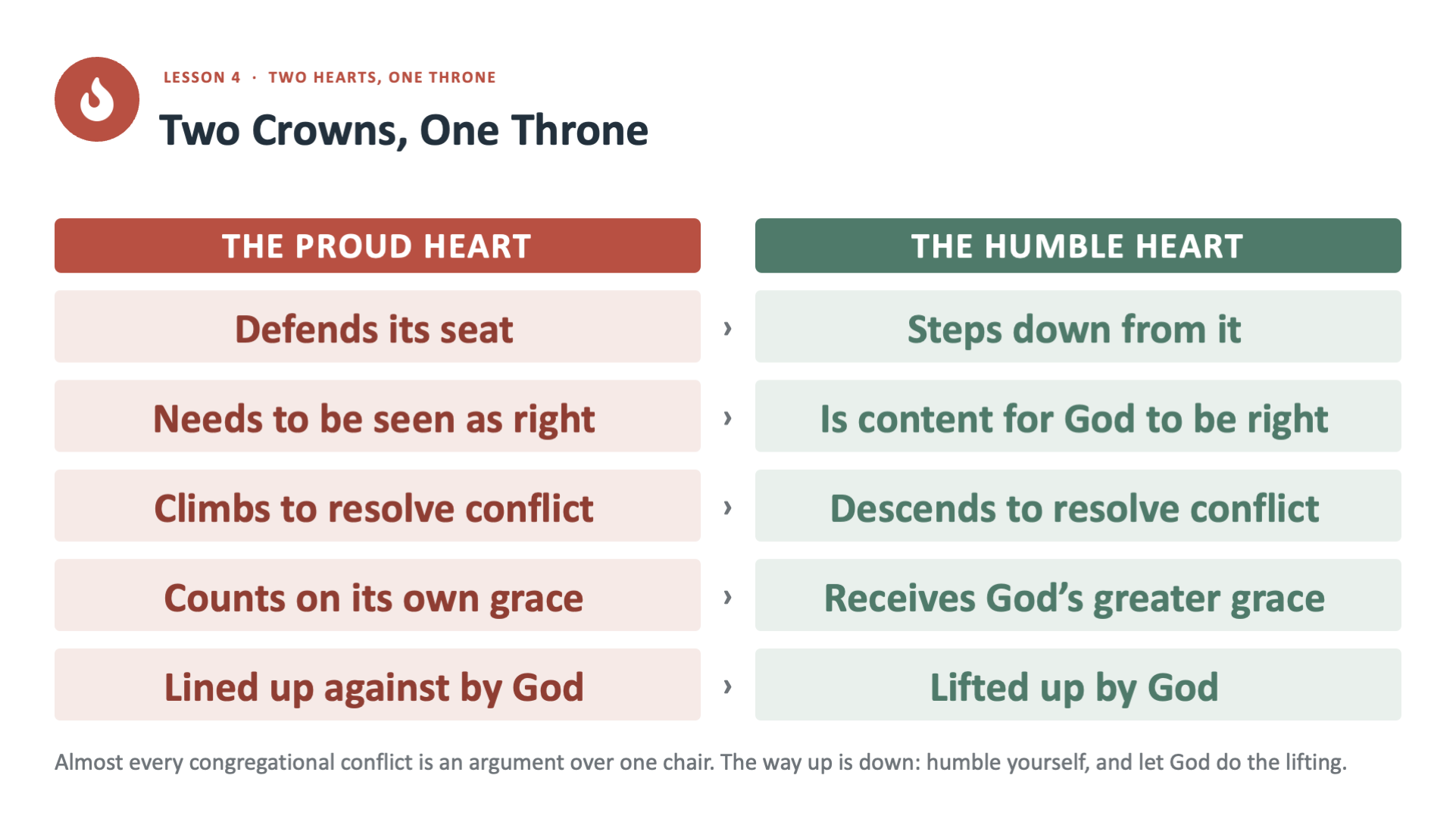
Run your finger down the left column and notice how exhausting it is. The proud heart can never rest, because the seat always has to be defended, the rightness always has to be displayed, and the climb never reaches a summit where you finally get to stop. Now read the right column. Every line in it is lighter. The humble heart is freer, not weaker, because it has put down a weight the proud heart insists on carrying forever: the weight of being its own god. James says you can set it down. You weren’t going to keep that throne anyway.
Humbling Is Not Humiliation
It would be easy to mishear this lesson and conclude that the answer to conflict is to think badly of yourself, to grovel, to become a doormat that any strong personality can wipe his feet on. That’s not what James means, and it’s worth saying plainly, because false humility breeds its own kind of conflict, just a quieter and more passive-aggressive kind.
Look again at where the staircase ends. “Humble yourselves before the Lord, and he will exalt you” (4:10). Biblical humbling isn’t self-hatred; it’s self-forgetting in the presence of God. The humble person isn’t the one who says “I’m worthless.” He’s the one who has stopped keeping score of his own worth altogether, because his eyes are on the Lord instead of on the mirror. He can lose an argument without losing himself, because his standing was never staked on winning. He can let a brother have the good seat, the credit, the last word, because his name is written somewhere safer than the moment’s outcome.
That’s why genuine humility is the most powerful thing you can bring into a fight. The proud man has to be defended at every point, so every disagreement is a threat. The humble man has nothing to protect, so he can listen, yield where he should, hold firm where he must, and never confuse the two with his ego. The goal isn’t a congregation of people who think little of themselves. It’s a congregation of people who have stopped thinking about themselves long enough to actually see each other.
Bringing It Home
If conflict has a favorite fuel, it’s pride. The need to be right. The need to be respected. The need to win, to not back down, to make sure everyone knows whose fault it really was. Every one of those needs feels reasonable in the moment, and every one of them is the engine James named in one short verse: “God resists the proud.”
So humble yourself, and let God do the lifting. You don’t have to defend your seat, because the throne was never yours to keep and you weren’t going to hold it by force anyway. You don’t have to win the argument, because the grace you actually need is greater than any argument and it only comes to the low. The next time you feel yourself digging in, getting taller, reaching for the last word, hear the verse underneath it all. God resists the proud. That alone is reason enough to climb down, and the hand that catches you on the way down is the one you were really fighting to reach the whole time.

This is definitely worth listening to multiple times
I’m a slow learner
But this is so helpful thank you
Very good, thanks Matt I needed that.
Ricky D.