


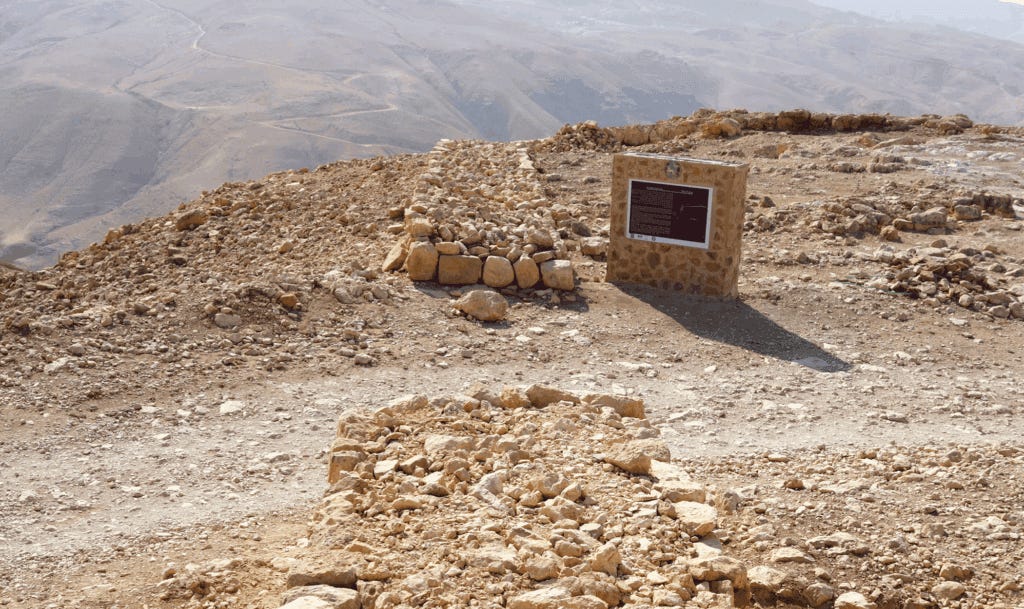
What do you remember about the story of Balaam?
For most of us, it’s the talking donkey. Maybe a vague recollection of a false prophet, a warning about teachers who lead people astray. That’s where the story tends to live in our memory, filed somewhere between “strange Old Testament moment” and “cautionary tale for church leaders.” And honestly, that’s not wrong. But there’s a lot more going on once you actually get into it.
There’s a moment in Numbers 22 that we fly right over.
Israel is camped on the plains of Moab, right on the edge of the Promised Land. The Jordan River is in front of them. Jericho is visible across the water. After forty years in the wilderness, they are this close. And they have no idea that on the heights above them, a king named Balak is in a panic, and a prophet named Balaam has just been hired to destroy them before they ever cross that river.
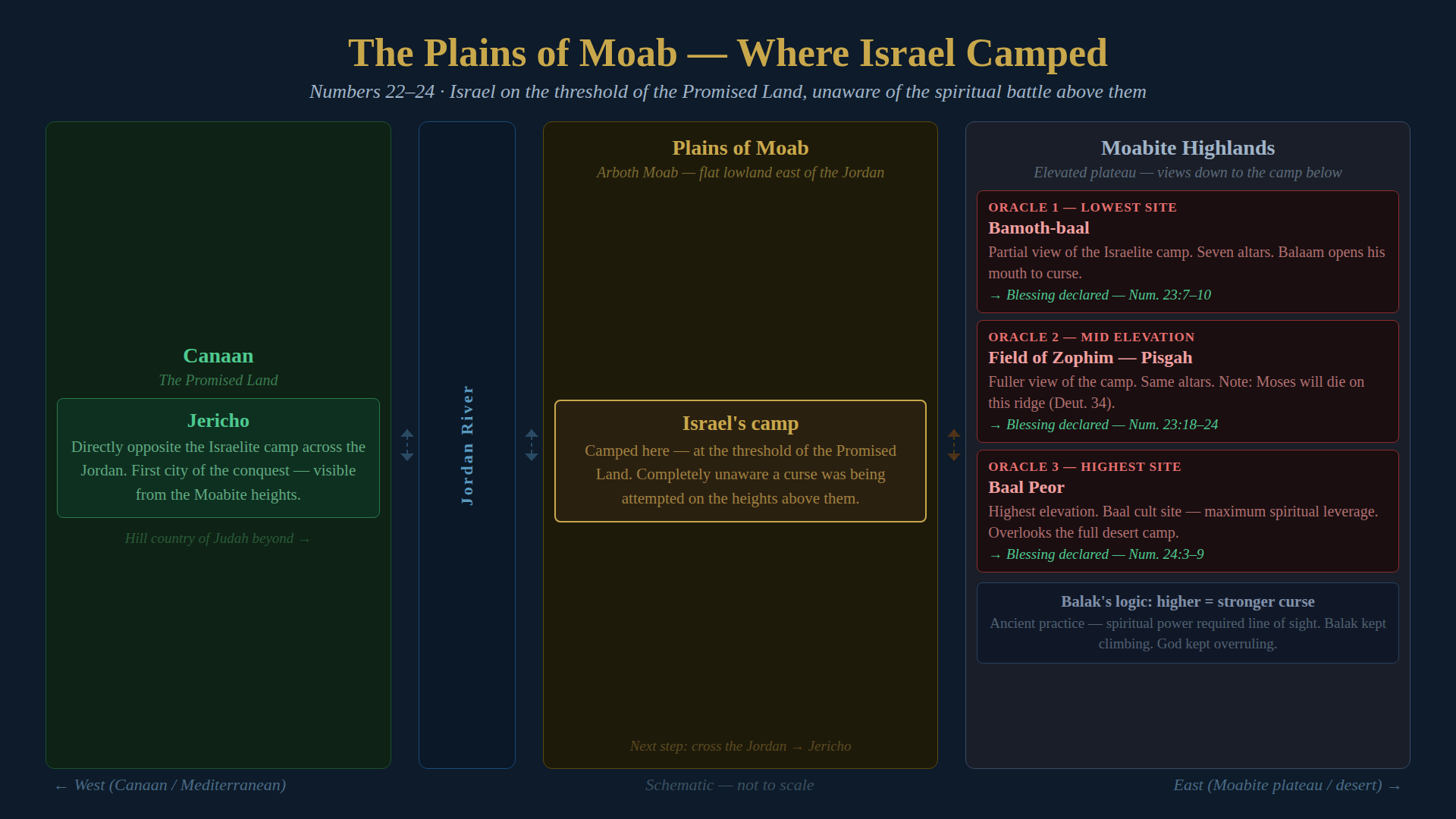
No alarm went off. No prayer was recorded. No one cried out for help.
God handled it before Israel knew there was anything to handle.
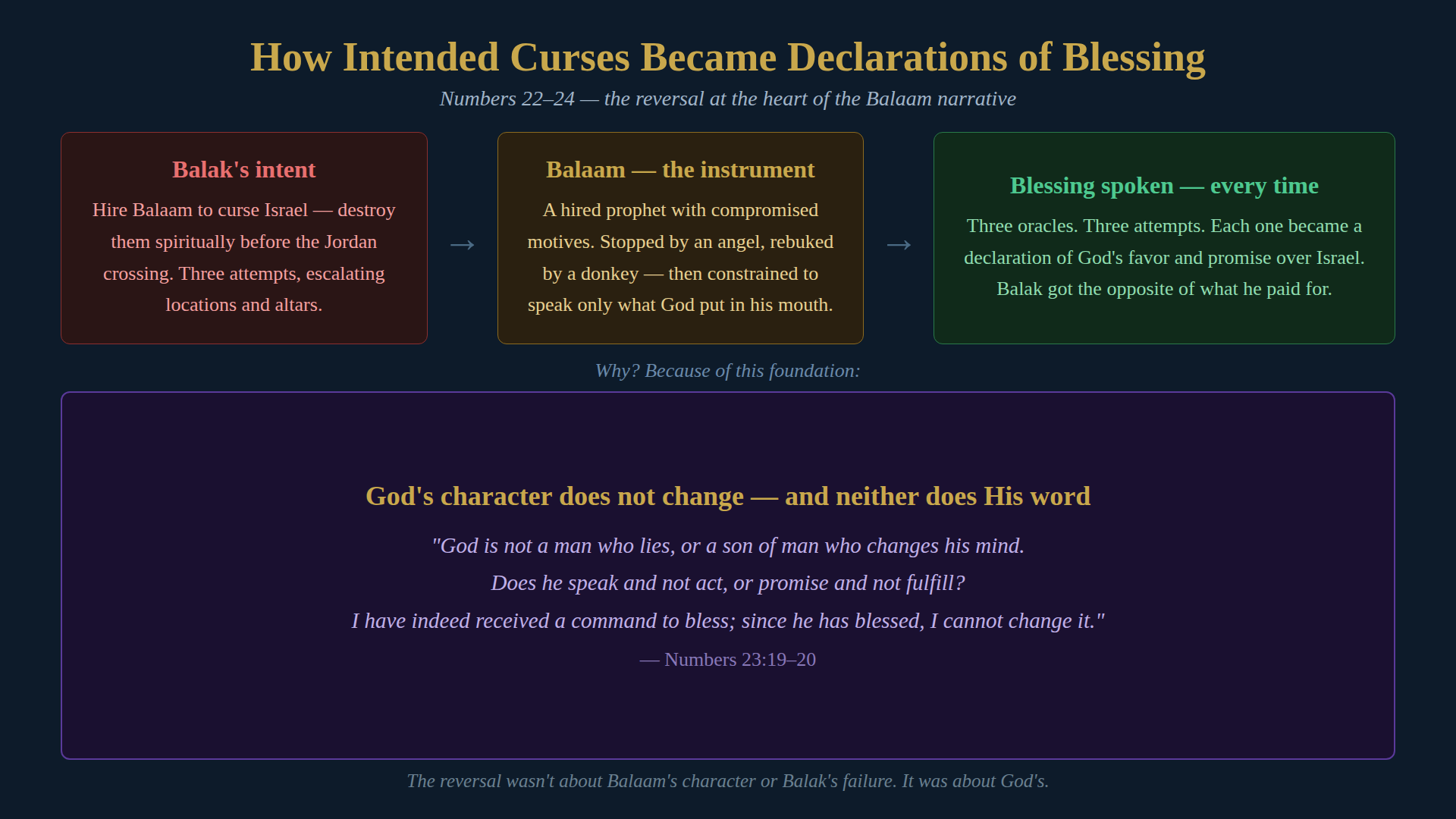
That detail should catch our attention. Because most of us live as though God’s protection is reactive, as if He waits for us to notice the threat, name it, and ask before He moves. But that’s not what happens here. Balak plots. Balaam saddles his donkey. And God, without any prompting from His people, quietly dismantles the whole scheme. Every time Balaam opens his mouth to curse, blessing comes out instead. Three locations. Three altars. Three attempts. Same result every time.
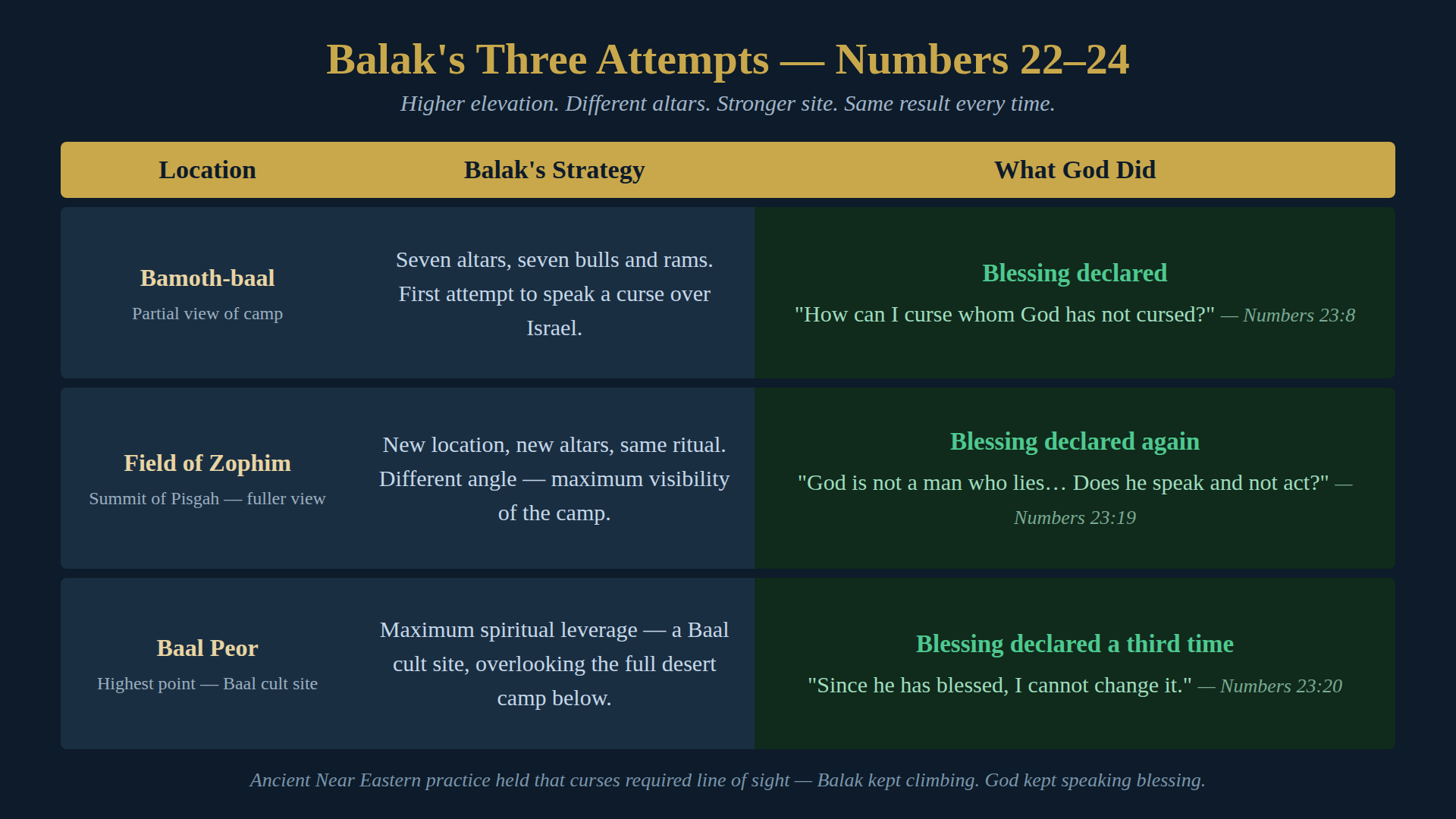
Israel never prayed about it because Israel never knew about it.
Here’s what that should do to us: it should make us genuinely humble about how little we understand of what God is doing on our behalf on any given day. The threats we never saw. The doors that never opened because God quietly closed them. The conversations that happened, or didn’t, without our knowledge or input. We tend to measure God’s faithfulness by what we can see, what we can track, what we can point to and say that’s where He showed up. But Balaam’s story suggests that a significant portion of God’s work in our lives is happening completely off our radar.
That’s not a reason for passivity. It’s a reason for trust.
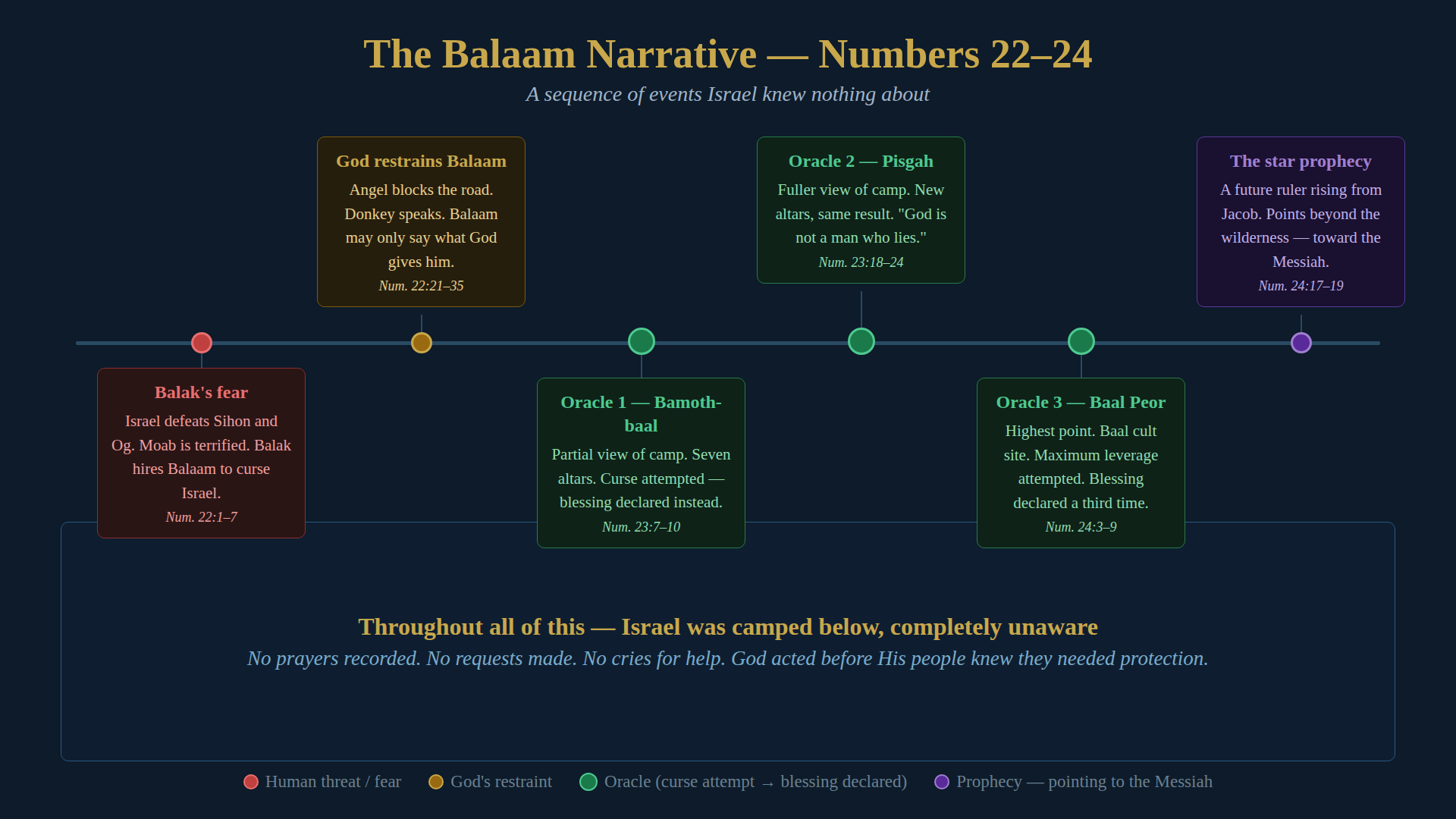
Now here’s where it gets uncomfortable.
Take a good look at Balaam. He’s not a hero. He had compromised motives; he was hired, after all, and the text doesn’t let us forget it. He had to be stopped by an angel and rebuked by his own donkey before he got his bearings. He’s the last person you’d pick as the instrument through which some of the most sweeping blessings in the entire Old Testament get spoken over God’s people.
And yet. God used him anyway.
This is worth more than a cursory observation, because most of us have a quiet assumption running beneath our faith: that God’s work depends on the quality of the available instruments. That if we’re inconsistent, or struggling, or somewhere in the middle of our own compromised season, God is essentially stuck. Waiting on us to get it together before He can do anything significant.
But Balaam’s story doesn’t support that reading at all. God constrained a reluctant, morally compromised prophet and used him to declare His purposes over His people. The instrument’s character didn’t determine the outcome. God’s sovereign intention did.
That should challenge us. And then it should free us.
But here’s what holds all of this together, and it’s the most important piece: what actually protected Israel in the plains of Moab wasn’t their prayers, their awareness, their faithfulness, or their track record.
Look at where they were at this point in the story. These are the same people who had grumbled at the Red Sea, built a golden calf at Sinai, rebelled at the report of the spies, and just chapters earlier had been complaining about the manna again — the same provision that had kept them alive for decades. Their consistency was not the variable.
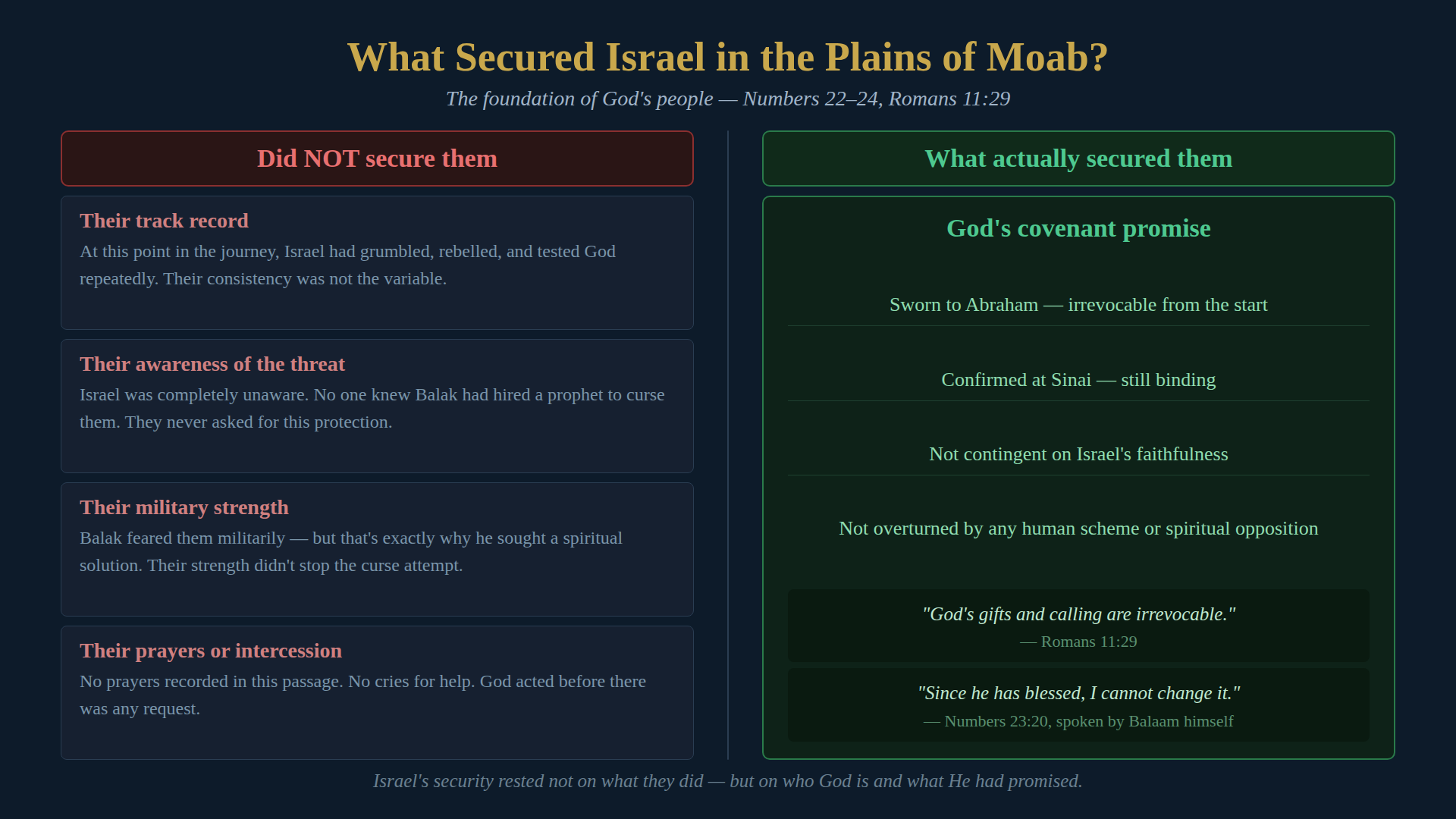
What protected them was God’s covenant promise. Sworn to Abraham. Confirmed at Sinai. Still binding, not because Israel had earned it, but because God had spoken it. And God, as Balaam is forced to confess, is not a man who lies, or a son of man who changes his mind.
That word from Balaam’s own mouth, spoken by a hired enemy standing on a pagan high place, is one of the most remarkable testimonies to God’s faithfulness in all of Scripture. He can’t curse them. Not because Israel is so righteous. Because God has blessed them, and that blessing cannot be changed.
And what secured that blessing wasn’t Israel’s performance. It was God’s covenant, His sworn commitment to a people He had chosen and redeemed. That’s not a statement about what Israel could get away with. It’s a statement about who God is. He doesn’t abandon His purposes. He doesn’t walk away from what He has spoken. He is not, as Balaam himself was forced to say, a man who lies, or a son of man who changes his mind.
The security is in His character. And for those who are in Christ, who have responded to His call in faith and obedience, that same unchanging character is the ground beneath your feet.
So here’s the question the Balaam story puts to all of us: what are you resting on?
If it’s your consistency, your prayer life, your spiritual discipline, your sense that you’ve been doing enough, then your security is more fragile than you think. Because the moment you have a bad month, a season of doubt, a stretch where the faithfulness isn’t coming easily, that foundation starts to shift.
But if what you’re resting on is God’s promise, sealed in the blood of Christ, confirmed by an empty tomb, held in the hands of a God who doesn’t lie or change His mind, then nothing the enemy plots and nothing he schemes can touch it.
They were trying to curse you. On the heights above you, unseen and unheard, the schemes were already in motion.
And God had already handled it.
