


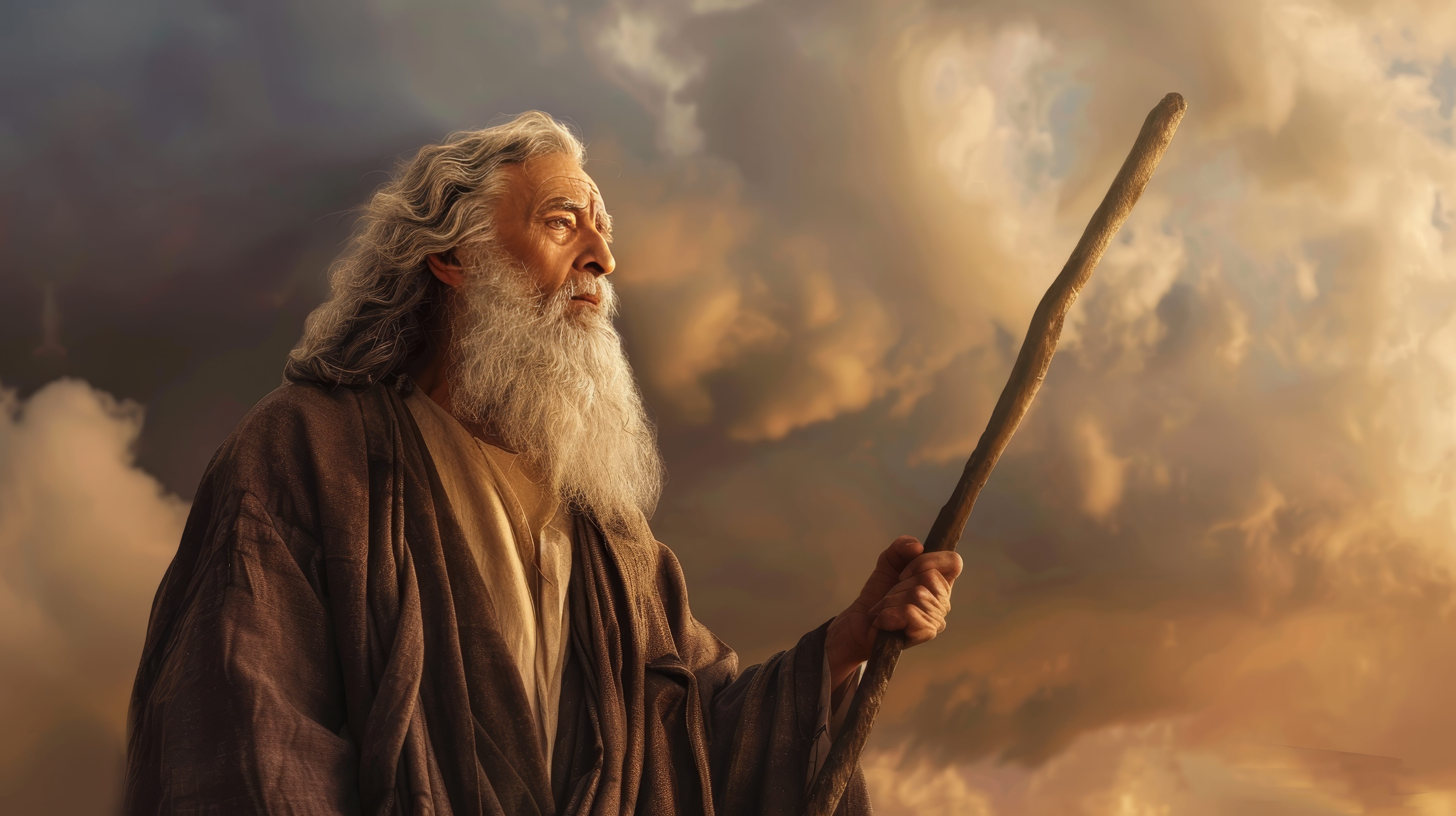
Moses had run out of excuses, so he reached for one more.
What if they don’t believe me and don’t listen to me but say, “The Lord did not appear to you”? Exodus 4:1. He had already tried, Who am I that I should go to Pharaoh, Exodus 3:11. He had asked for a name to hide behind: Exodus 3:13. Now he puts it on the crowd. They will never listen. Nobody in Egypt is going to take the word of a fugitive who has been gone forty years.
God does not argue with him. God asks him about a stick.
The Lord asked him, “What is that in your hand?” Exodus 4:2.
A Shepherd’s Stick
Moses looks down and answers, A staff.
Think about what that piece of wood meant to him. He was raised in Pharaoh’s household and educated in all the wisdom of the Egyptians, Acts 7:22. He could have been holding a scepter. Instead, he is out past the far side of the wilderness, keeping the flock of his father-in-law, Jethro Exodus 3:1. The sheep were not even his. That staff was perhaps one of the few possessions of his second life.
So when God asks the question, God is not asking for information. He is asking Moses to look honestly at what forty wasted-looking years had put right in front of him.
Throw It Down
Throw it on the ground. Moses does, and the staff becomes a snake, and Moses runs from it, Exodus 4:3.
Then comes God’s instructions. Stretch out your hand and catch it by the tail, Exodus 4:4. Anyone who has ever dealt with a snake knows you reach for it behind the head. God tells him to grab the wrong end. Moses obeys, and the thing goes stiff in his fist, and he is holding his old staff again.
Notice the order. It had to leave his hand before it could come back with power in it. What we clutch stays what it was. What we hand over, God can use.
Moses is not finished objecting. The signs are settled, so he moves the trouble off the crowd and onto himself. Please, Lord, I have never been eloquent, he says, and then, my mouth and my tongue are sluggish, Exodus 4:10. Watch how God answers. He asks another question. Who placed a mouth on humans? Who makes a person mute or deaf, seeing or blind? Is it not I, the Lord? Exodus 4:11. Then comes the promise. Now go! I will help you speak, and I will teach you what to say. Exodus 4:12. That reluctant, sluggish tongue was one more thing in his hand. Moses had carried it around for eighty years, calling it a disqualification.
Whose Staff Is It Now?
A small phrase in verse 20 is easy to read past. As Moses prepares for the trip to Egypt, the text says, And Moses took God’s staff in his hand, Exodus 4:20.
Eighteen verses earlier, it was a staff. Now it belongs to God. Nothing about the wood had changed. Same knots, same weathering from forty years of sun. The difference is ownership.
Watch where that stick shows up after this. Lift up your staff, stretch out your hand over the sea, and divide it, Exodus 14:16. It strikes the rock at Horeb and water comes out for a whole nation to drink, Exodus 17:5-6. It goes up on a hill above a battlefield while Israel fights Amalek in the valley, Exodus 17:9. A shepherd’s walking stick, cut somewhere in Midian, ends up parting a sea.
Centuries later, a prophet asks the same question. A widow comes to Elisha with her husband in the grave and a creditor at the door, ready to take her two boys as slaves to settle the account, 2 Kings 4:1. Elisha does not take up a collection. He says, Tell me, what do you have in the house? Her answer is next to nothing. Your servant has nothing in the house except a jar of oil, 2 Kings 4:2. So he tells her to borrow every empty vessel in the neighborhood, shut the door behind her, and start pouring. She pours until there is not one jar left to fill, and the oil stops the moment the last one is full, 2 Kings 4:6. She sells it, clears the debt, and she and her sons live on the rest.
She had written that jar off as too small to count. It was the only thing God asked about.
Jesus Asks the Same Question
Five thousand men are sitting on a hillside, and the disciples want them sent home. Jesus tells the Twelve to feed them, which is not remotely possible. Then he asks, How many loaves do you have? Go and see, Mark 6:38.
Go count it. That is the whole assignment. They come back with five loaves and two fish, a boy’s lunch set against the size of the problem. Jesus takes it, blesses it, breaks it, and twelve baskets of leftovers are carried off that hill.
He never asked them to produce what they did not have. He asked what was already in their hands.
The Question Comes to You
Most of us are waiting on equipment. We would serve if we had more training, more confidence, a better story to tell, a schedule with some room in it. Meanwhile we look at what we are carrying and decide it is too simple to matter. A truck. A kitchen. A set of tools. A trade we have practiced so long we have quit thinking of it as a skill.
So what is in your hand this morning? How much of your life have you written off as a detour, when God may have spent those years teaching you to hold something? Have you thrown it down yet, or are you still gripping it and calling it too ordinary to offer?
God did not send Moses back to Egypt with a new tool. He sent him with the old one and His own name on it.
