



What is the source of wars and fights among you? Don’t they come from your passions that wage war within you? You desire and do not have. You murder and covet and cannot obtain. You fight and wage war. You do not have because you do not ask. You ask and don’t receive because you ask with wrong motives, so that you may spend it on your pleasures.
– James 4:1-3
James opens chapter 4 the way a careful doctor opens an appointment. Where does it hurt, and why? “What is the source of wars and fights among you?” He could have asked who started it or whose fault it was. Instead, he looks for the spring beneath the surface water. You can do something about a spring. You can argue about who splashed whom all day long and never get things worked out.
This is the beginning of a 5-part series on a study of James and overcoming conflict inside a local congregation. One thing I recently learned from a friend is the strong connection between this short epistle and Jesus’ teaching in the Sermon on the Mount. Each day, we’ll examine how James's writing progresses, helping the first Christians repair and restore their relationships. We’ll also see that it is a direct application of the principles that James’ brother, Jesus, taught while on earth.
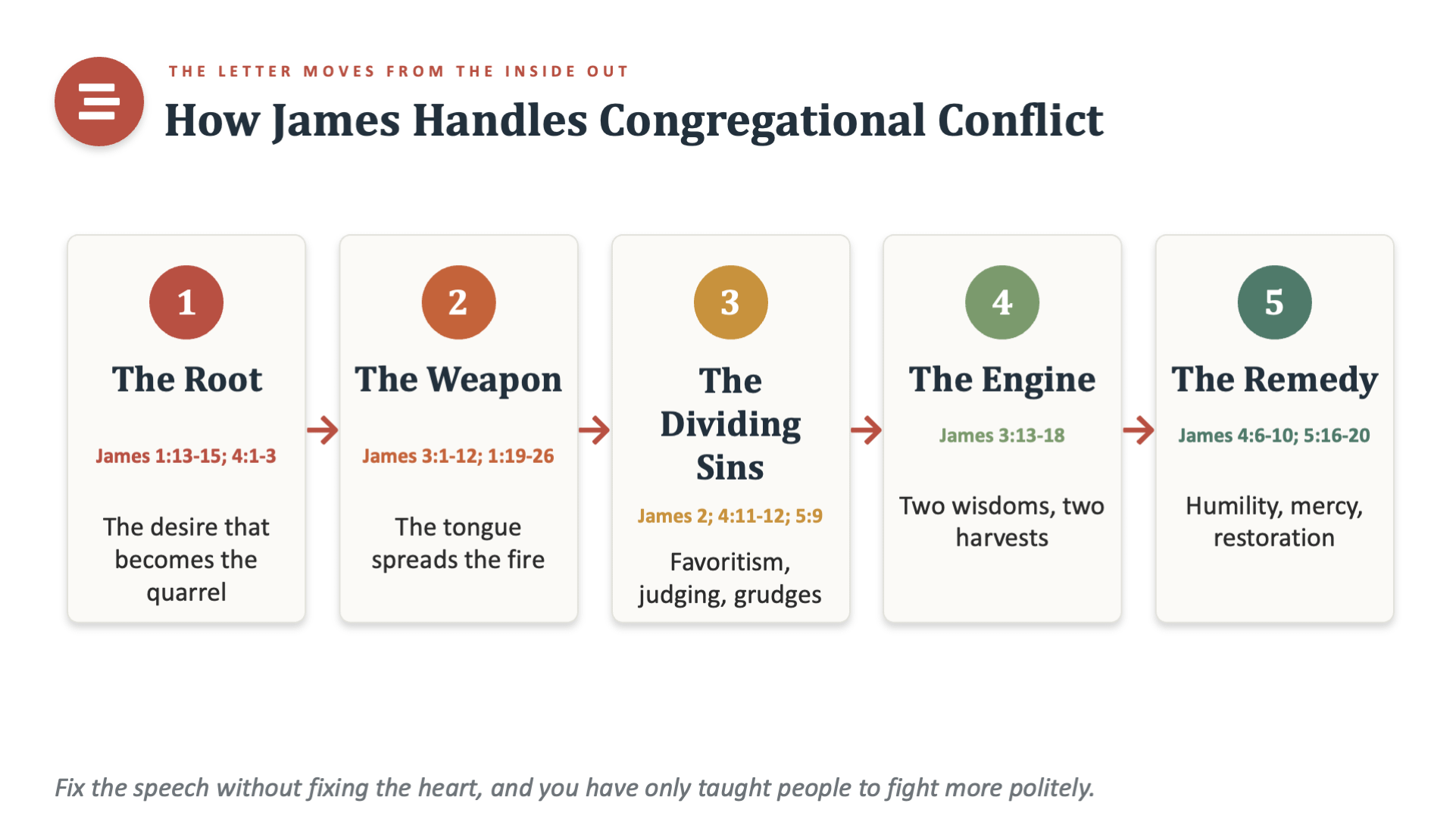
The two words he uses in James 4:1 are worth our examination. “Wars” is the standing hostility, the cold front in a congregation where everybody already knows which families won’t sit near each other. “Fights” is the particular blowup, the thing that happened in the parking lot last Sunday. James names both, then says they run back to a single source. The episode you can describe and the chill you can feel turn out to be the same illness wearing two faces.
Most of us handle conflict as a string of separate events, each with its own villain. James wants us to step back and see that a pattern this consistent has a cause this consistent, and the cause lives closer to home than we’d like.
The War is Inside Before It’s Among
The source of the trouble “among you,” he says, is the passions “that wage war within you.” There’s already a war on, and it isn’t between you and your brother. It’s inside your own chest, and it was running long before anyone else walked into the room.
“Passions” is the word behind our “hedonism.” It means cravings and appetites, and they aren’t always sinful on their face. It can be as simple as a hunger to be respected, to be comfortable, or to win the point. The trouble is that these hungers don’t sit still. James says they wage war. They take ground. And when the appetite inside you runs into the appetite inside someone else, the private fight goes public.
It explains how two people who genuinely love the Lord and have loved each other for years can still destroy a relationship over preferences and differences in judgment. Whatever the point of disagreement was never the real subject. Each of them carried a hungry appetite into the conflict; the appetites collided, and everyone told themselves it was about principle.
Watch a Quarrel Be Born
James diagrammed this back in chapter one, and the picture is grim. A person gets dragged off and baited by “his own evil desire.” Desire then “gives birth to sin.” Sin grows up and “gives birth to death” (1:14-15). Desire is the mother, sin the child, death the grandchild, and each generation comes out worse than the one before.
Set that next to the escalation in 4:2, and you can watch it move.
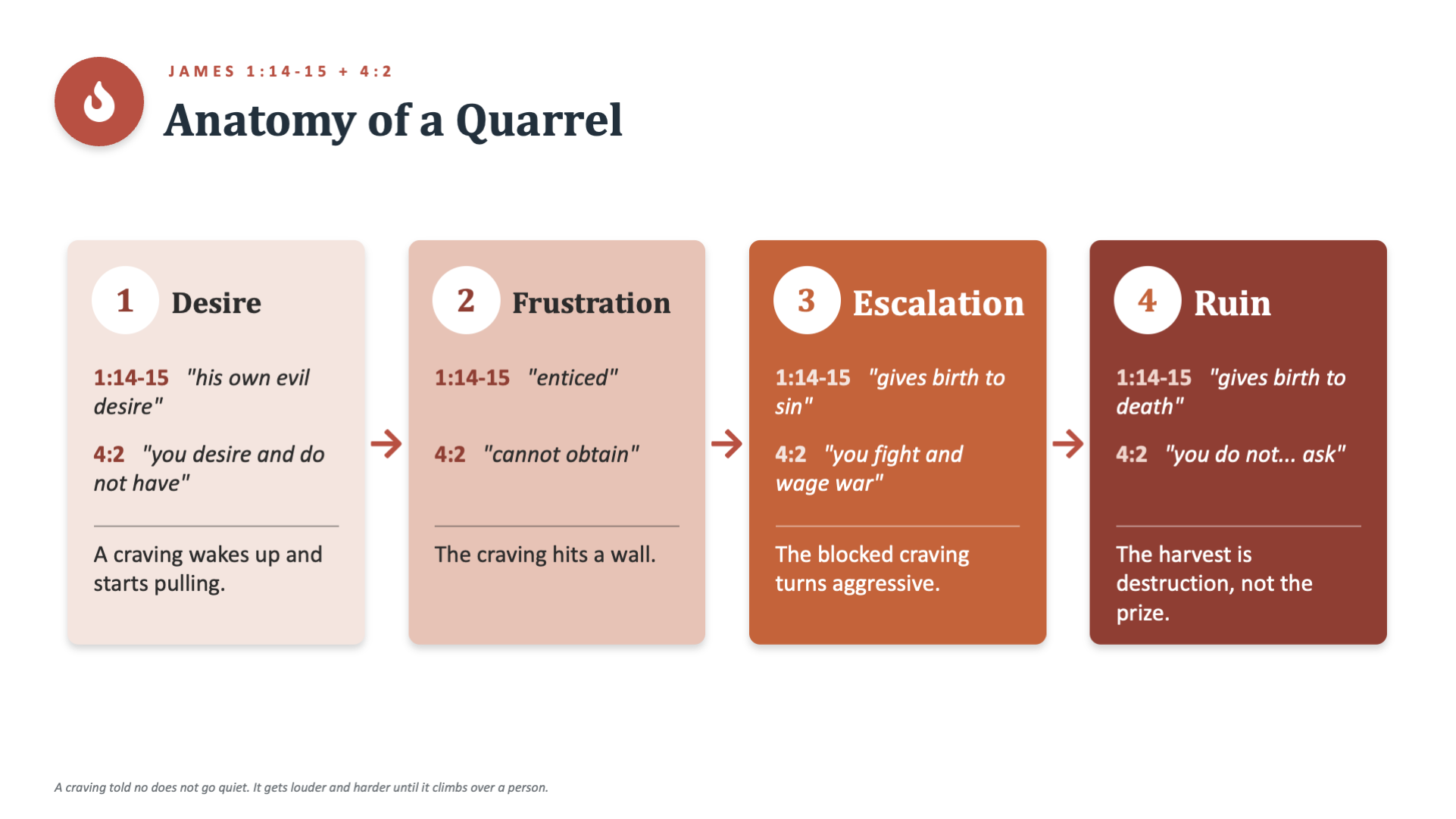
See how it builds. A craving that gets what it wants goes quiet. A craving that gets told no does not. It gets louder and harder until it’s willing to climb over a person to reach what it came for. The blowup that results is an appetite that hit a wall.
The Word That Stops You Cold
Midway through verse 2, James says, “you murder.” The imagery is obviously more heated rather than literal, and some have tried to soften it. But James most likely meant it, because it lands where Jesus landed. In the Sermon on the Mount, Jesus took the old command against murder and ran it back to the root: the person who is angry with a brother is already answerable (Matt 5:21-22). Murder begins long before the weapon, in a heart that has quietly written someone off.
So James isn’t grabbing for shock value when a frustrated craving ends in “murder.” He learned it from his brother. The anger you keep warm toward another Christian, the contempt, the low wish that they’d just leave (or I’ll just leave), is the seed of the very thing Jesus named. James holds it up and tells you what it grows into if you keep feeding it.
Two Ways to Botch a Prayer
Then James turns the diagnosis over, and the turn happens in the middle of a sentence. He’s had them wanting, failing, and fighting, and then he adds five words that change the direction of the whole paragraph: “you do not have because you do not ask” (4:2). Everything up to that point has been horizontal, people grabbing at each other. Now, this one clause makes it vertical. The hands that are driving the war are empty because nobody carried the want to God in the first place. The quarrel rushed in to fill the space where the asking should have been.
Verse 3 then answers the objection you can almost hear forming in the room. Someone would say, “But we do pray.” James grants it and shows why the praying fails anyway: “You ask and don’t receive because you ask with wrong motives, so that you may spend it on your pleasures” (4:3).
Two different failures sit in those verses.
The first is prayerlessness. A whole congregation, clawing for things they never once carried to God. They’ll lobby, maneuver, and fight for it, but they won’t ask for it. They’ll give an hour to building a case against a brother and not five minutes to praying about what they actually want. The empty hands are self-inflicted.
The second is harder to spot, because it wears a spiritual face. These people do pray. But they pray the way a kid asks for cash, with the spending already planned. They want God to underwrite the appetite. They aren’t asking to be changed; they’re asking to be funded, and that prayer goes nowhere, because God will not hand you ammunition to use on your brother.
The word James reaches for in verse 3 ties the whole paragraph shut. “Pleasures” here is the same Greek word he used back in verse 1 for the “passions” that wage war within you. He opened by pinning the fighting on the appetite, and he closes by catching that same appetite with its hand in the prayer. So the brawl in verse 2 and the self-serving prayer in verse 3 aren’t two problems. They’re one craving turning up in two places, which is why the very next verse can move straight to adultery and friendship with the world (4:4). A heart set on having its way will use a brother to get there, and it will try to use God the same way.
Hold that against what Jesus said in the same sermon. “Ask, and it will be given to you” (Matt 7:7). He drew God as a Father glad to give good things to His children. James agrees that the door is open. He’s already promised that every good gift comes down from the Father above (1:17). So the breakdown isn’t a tight-fisted God. It’s a request he loves us too much to grant, or a request we never get around to making.
And there’s one prayer in this letter that comes back answered every time. Ask for wisdom, James says, and God “gives to all generously” (1:5). The wisdom that comes down from above is “peace-loving” (3:17), which is the very thing that would have ended the fight. The prayer that could have dissolved the conflict was on the table the whole time. They were either not praying it, or asking for the wrong thing.
Quit Blaming Something Else
James pulls up one more root, close to the others. When you’re tempted, he warns in 1:13, don’t say you’re “being tempted by God.” We are forever trying to move the cause of our trouble somewhere outside ourselves. “God arranged it.” “The circumstances cornered me.” “That person made me do it.” James keeps walking the blame back home, past the situation and past the other people, until it arrives at “his own evil desire” (1:14).
This is the hard part, and it’s also what opens the door to peace. As long as the fire is someone else’s fault, you’re stuck, because you can’t repent of what another person did. Own the craving that’s actually driving you, and now you have something to bring to God. The person who continues to deflect the blame will never find peace. The one who admits he has contributed to the problem moves toward resolution.
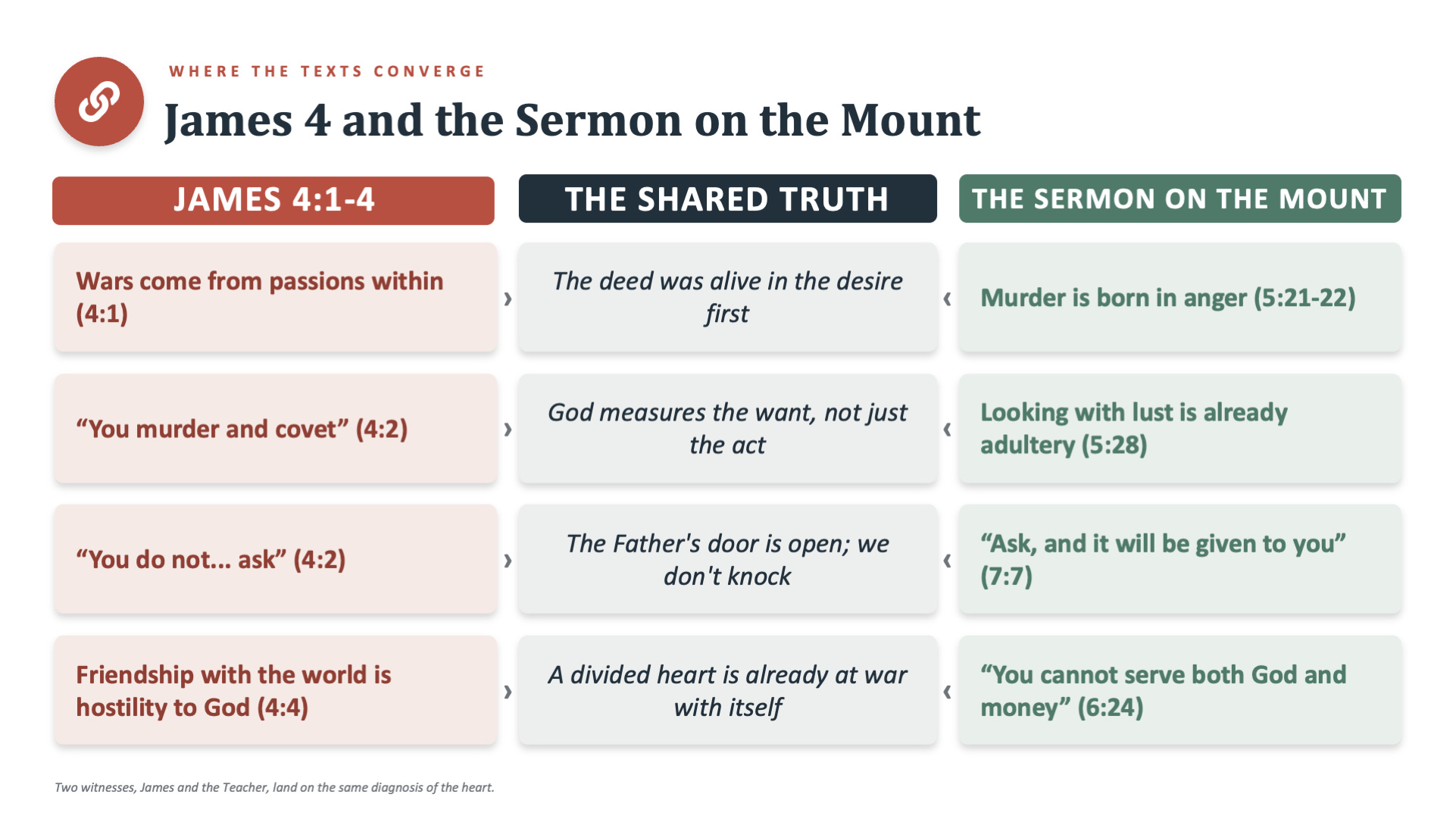
Stay on the last row a moment. James says in 4:4 that friendship with the world is hostility toward God, and Jesus says in 6:24 that no one can serve two masters. The war among brethren is the visible edge of a quieter war between two loves. Settle which master you serve, and a surprising number of fights lose their reason to keep going.
Bringing It Home
Here is a question to ask before you take a side, assign blame, or draft the perfect text message. What do I want here that I’m not getting?
This will humble you, because there’s almost always an answer, and it’s seldom noble. Usually, it’s some version of wanting to be right, to be respected, or to be in control. Once you’ve named it, the fight looks less like a principled stand and more like an appetite in church clothes. Then comes the move the fighters in James wouldn’t make. Take it to God. Not “Lord, fix them,” but “Lord, this is what I’m hungry for, and I’m bringing it to you instead of taking it by force.”
That one shift, from grabbing across the room to asking on your knees, drains most conflicts of their fuel. The war among you was always the runoff of the war within you. Win that one in prayer, and there’s far less left to fight about anywhere else.

I think you really got to the heart of this passage. You cleared up the use of “murder” in the text for me. What Bible translation are you using? Thanks.