
In yesterday’s article, we took a long look at the tongue, which becomes the little fire that spreads the conflict.

Today, we will follow that fire to one of the places it loves to burn hottest: the moment a Christian sits in judgment on another and then says so out loud. James puts the two together on purpose. “Don’t criticize one another, brothers and sisters” (4:11). The slander he names in the same breath as judging is the tongue from chapter three, now loaded with a verdict.
You know, we almost never run a brother down without first having tried him. The cruel word in the parking lot didn’t come from nowhere. It came from a private courtroom where the case was heard, the evidence was weighed one-sidedly, and the sentence was handed down, all before the person opened his mouth. James reaches past the spoken slander to the silent trial behind it. The words were bad. The bench you climbed onto to say them was worse.
James doesn’t soften his teaching. In fact, he treats judging a brother not as a personality flaw or a bad day but as a specific kind of trespass, a reach for a seat that was never yours.
The Sin We Don’t Call a Sin
Why is this problem so difficult?
Most of the sins that wreck a church announce themselves. We know envy is ugly. We know slander is wrong even while we’re doing it. But judging a brother feels like discernment. It feels responsible, even righteous. We tell ourselves we’re just being honest, just facing facts, just calling it like it is. The verdict comes dressed as maturity.
But notice how James strips off the costume. He says when you set yourself up over a brother this way, you’re not being discerning, you’re “speaking against the law and judging the law” (4:11). Look at what he’s describing. God gave a law: love your neighbor as yourself (2:8). When you appoint yourself judge of your neighbor, you’ve quietly set that law aside as though it didn’t apply to you, as though you’d been promoted above it. “If you judge the law, you are not a doer of the law but a judge” (4:11). You’ve stopped obeying the command and started grading it.
The proud verdict you pass on a brother isn’t only an offense against him. It’s an offense against the God who wrote the law you just stepped over. You made yourself the exception. And there is no smaller, more crowded throne in all the world than the one a self-appointed judge climbs onto, because everyone wants it and nobody was given it.
One Lawgiver and Judge
Now verse 12: “There is one lawgiver and judge who is able to save and to destroy. But who are you to judge your neighbor?”
The bench has a single seat, and it’s already filled. What can the occupant do? He “is able to save and to destroy.” Hold your own record up against that. You cannot save a soul. You cannot destroy one. You cannot read the heart that produced the behavior you’re so sure about. You weren’t in the room for half the story, you can’t weigh the wounds and fears and history that drove it, and you certainly can’t see where it all ends. The one Judge can do every bit of that. You can do none of it.
So the question at the end of the verse isn’t rhetorical filler. “Who are you?” James genuinely wants an answer because the honest answer dismantles everything. Who are you to read a motive you can’t see, to close a case you only heard one side of, to pronounce on a soul you have no power to save or lose? Set next to the actual Judge, our confident verdicts look like a child banging a toy gavel and believing court is in session.
The Judge Is at the Door
Now, let’s move over to chapter five, where James ties judging a brother to the grudge. You know, that low-grade, long-running resentment that so many conflicts finally settle into. “Brothers and sisters, do not complain about one another, so that you will not be judged. Look, the judge stands at the door!” (5:9).
Feel the nearness in that. The Judge isn’t somewhere far off at the end of history, a distant figure we’ll meet eventually. He’s “at the door,” hand on the latch, close enough to hear the very grumbling James is warning about. We complain about a brother as though the conversation were private, just us and the person we’re venting to. James says there’s already a third party in the room, and he’s the one with the authority we’ve been borrowing without permission.
There’s a sharp warning folded into it, the same one Jesus gave. Complain about your brother “so that you will not be judged.” The grudge you’re nursing doesn’t just hang in the air. It calls down the same scrutiny onto you. You build a case against a brother and discover you’ve been building the dock you’ll stand in. The Judge at the door swings both ways.
The Measure You Use
Behind all of this stands the principle James laid down back in chapter two, the one that governs every verdict we’re tempted to pass. “For judgment is without mercy to the one who has not shown mercy. Mercy triumphs over judgment” (2:13).
That’s the rule of the court, and it’s exact. The measure you hand out is the measure that comes back to you. Show no mercy, and you’ve requested a trial conducted on those same terms, which is the last thing any of us should want, because no one survives a merciless reckoning. But the verse doesn’t end on the threat. It ends on a victory: “mercy triumphs over judgment.” Mercy isn’t the weaker option, the thing you settle for when you’re too soft to render the verdict. Mercy wins. It out-muscles judgment. When you choose to be merciful to a brother who has it coming, you’ve sided with the thing that beats the gavel.
This is why getting off the judgment seat isn’t resignation or pretending the wrong didn’t happen. It’s a transfer. You hand the case to the only Judge qualified to try it, and you trust that His mercy, the mercy you’re counting on for yourself, is large enough for the brother too.
Back to the Sermon on the Mount
None of this is new with James. He’s preaching his brother’s sermon again, and on the subject of judging, the words are almost the same.
Jesus opened the last stretch of the Sermon on the Mount with it. “Do not judge, so that you won’t be judged. For you will be judged by the same standard you use, and the measure you use will be measured to you” (Matthew 7:1-2). Lay that beside James 2:13 and 4:12 and 5:9, and you can see the younger brother working the same vein from three different angles. The standard you set is the standard you’ll be held to. Jesus said it first, in one sentence, and James spent his letter applying it to a quarreling church.
Then Jesus drew the picture that has never been improved on. “Why do you look at the splinter in your brother’s eye but don’t notice the beam of wood in your own eye?” (Matt 7:3). It’s the most honest cartoon of conflict ever sketched. We turn into microscopes on the small fault in someone else and somehow walk around with a 2 x 4 jutting out of our own face, never feeling it. The math is absurd on purpose. The thing in your eye is bigger than the thing in his, and you’re the one volunteering for eye surgery.
But notice what Jesus does not say. He doesn’t say leave the splinter alone. He says, “First take the beam of wood out of your eye, and then you will see clearly to take the splinter out of your brother’s eye” (Matt 7:5). The goal is still to help your brother see. Jesus isn’t banning correction; He’s ordering it. Deal with yourself first, get your own sight clear, and then, with clean hands and a humble eye, you can actually help. Condemning judgment says, “I’ll fix your eye and never mention mine.” Loving correction says, “Let me clear my own vision so I can be of some use to yours.”
Think of the Beatitude that runs underneath: “Blessed are the merciful, for they will be shown mercy” (Matt 5:7), which is James 2:13 in a single line. And tie it to the sentence Jesus tucked right inside the model prayer: “For if you forgive others their offenses, your heavenly Father will also forgive you” (Matt 6:14). The mercy you extend and the mercy you receive are bound together. You can’t pull them apart, no matter how badly you’d like to keep strict justice for your brother and tender mercy for yourself.
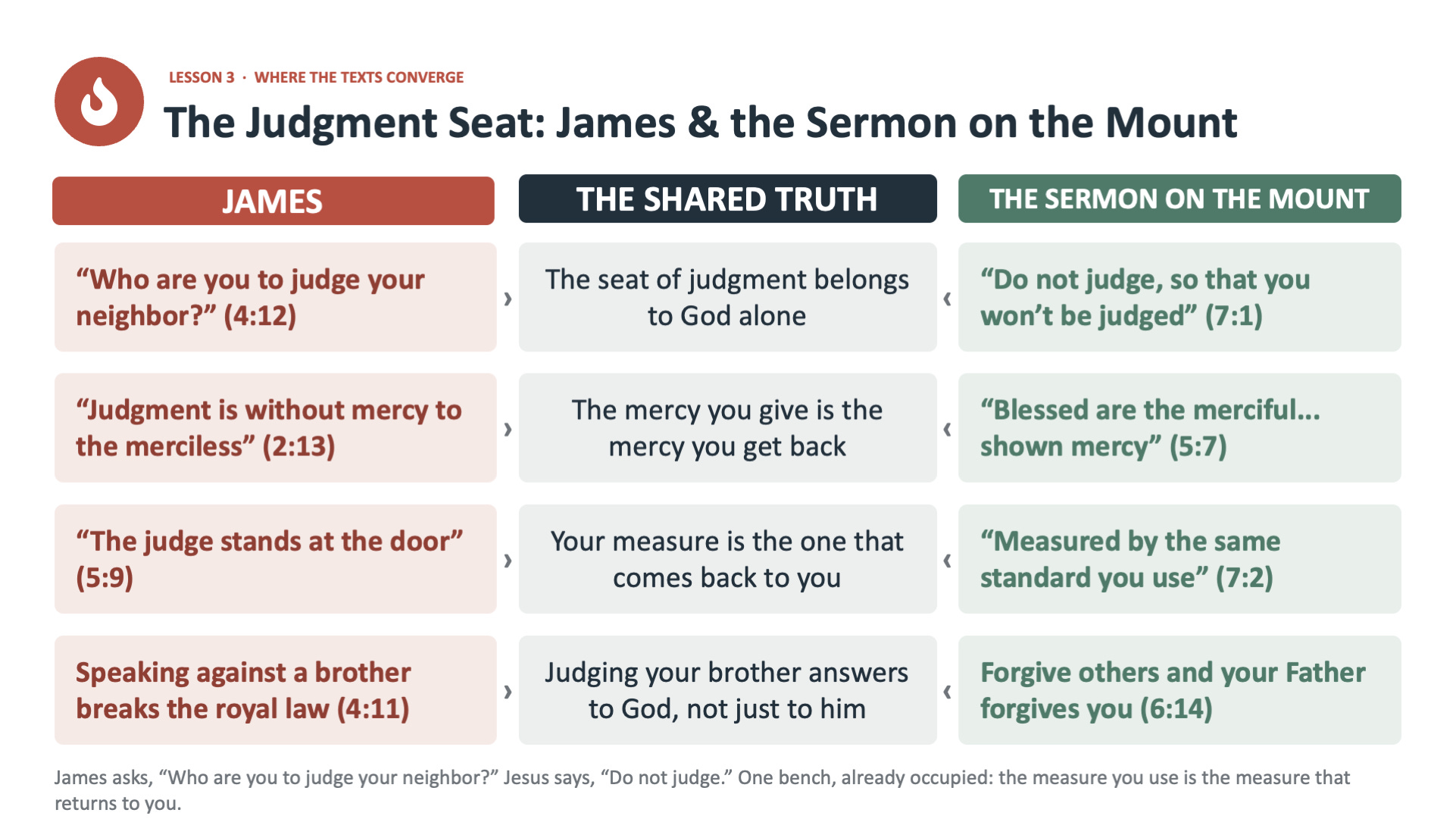
Stay on that top row a moment, because it carries the whole lesson. The reason "do not judge" isn't a ban on all discernment is that James and Jesus are both pointing at a specific seat, the one that pronounces final verdicts on souls. That seat is taken. The mistake isn't noticing a brother has a splinter. The mistake is climbing onto God's bench to sentence him for it.
God’s Chair and Yours
A great deal of congregational conflict comes from confusing two columns that were never meant to be mixed. Some things belong to God alone. Some things belong to you. Trouble starts the moment you reach across the line and grab His.
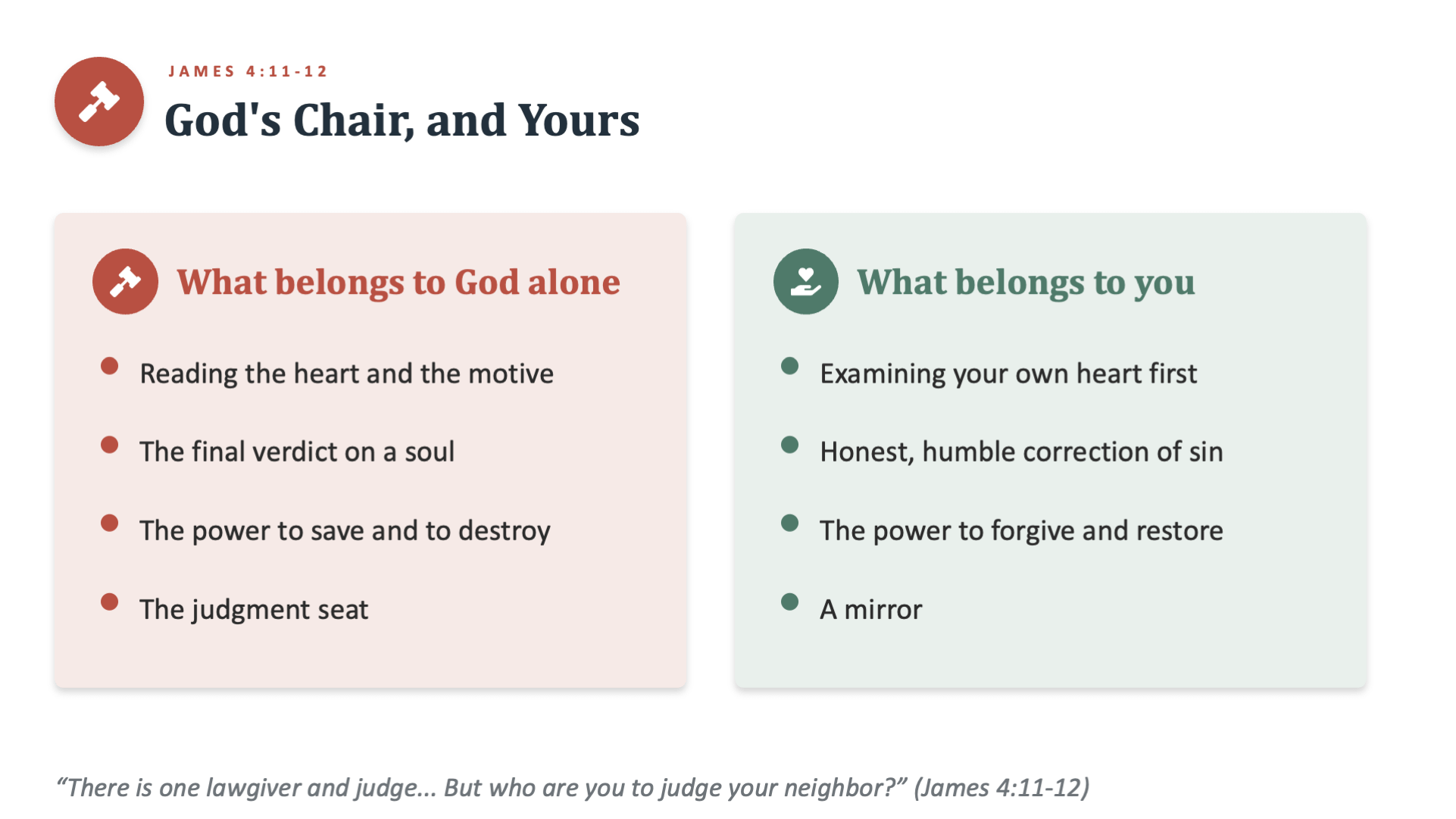
Run your finger down the left column and notice that every item requires something you don’t have: full knowledge, perfect fairness, and the authority over a soul’s destiny. Run down the right column and notice that every item is within reach, and each is humbling rather than exalting. God didn’t leave you with nothing to do about your brother’s sin. He left you plenty. Just none of it from the bench. Your work happens in front of the mirror and beside your brother, not above him.
Bridling the Verdict, Not Killing Discernment
Now, there may be some who’ve reached this point in this post and are starting to worry that the conclusion is that a faithful church must never evaluate anything, never name a sin, or never correct a wandering member, all in the name of “not judging.” That’s not what James means, and it’s not what Jesus means. The same James who says “who are you to judge?” also says, in the very last lines of the letter, that turning a sinner from the error of his way saves a soul from death (5:19-20). You can’t turn someone back from an error you refuse to acknowledge as an error. Some judgment of the act is built right into the rescue.
The line runs between the act and the soul, between the splinter and the eternal verdict. You’re equipped, and even commanded, to look at conduct against the standard of Scripture and call sin what God calls sin. However, you are flatly forbidden to crawl into God’s chair and pronounce on where a soul stands with Him. One is loving correction with your own beam already removed. The other is playing God. Discernment looks at the deed and consults the book. Judging, in the sense James condemns, looks at the person and consults the throne it has no right to sit on.
So the goal isn’t a congregation too timid to ever address a wrong, any more than the goal of guarding our tongue is a congregation too scared to speak. The goal is people who have learned the difference between holding up a mirror and banging a gavel, who correct gently because they remember they need correcting too, and who leave the final sentence to the One at the door.
Bringing It Home
The next time you catch yourself running a brother down, even silently, even in the privacy of your own head where you’re sure no one can hear it, let James ask you his question. Who are you? You’re not the Judge. You can’t read the heart, can’t see the whole story, can’t save or condemn a soul. And the real Judge is closer than you think, standing at the door, and He is merciful, and He is keeping the exact same measure you’ve been keeping.
That last part should change everything. The mercy you want when your own case comes up is the mercy you’re deciding the size of right now, every time you choose how to treat a brother who has wronged you. Hand out a merciless verdict, and you’ve named your own terms. Show mercy, and you’ve sided with the thing that triumphs over judgment.
So trade the gavel for a mirror. Take the beam out of your own eye before you go anywhere near your brother’s. Deal with the act honestly, leave the soul to God, and watch how many of your confident verdicts about other people quietly fall apart once you remember you weren’t the one appointed to render them.