



Yesterday, we covered James 4:1-3, talking about where wars and fights come from.

No congregation is immune to times of conflict. People are people: imperfect, opinionated, selfish, and sinful. We will bump into each other. As we saw, James gets down to the heart of the matter. Before we focus on the other person in the conflict, we need to examine our own passions.
What are the “passions” of James 4:1? Yesterday we said they are cravings or fleshly appetites: the hunger to be respected, to be comfortable, or to win the point. That’s true, and it’s a good place to start, because nobody minds admitting they’d like to be respected. In Galatians, Paul takes the same inner appetite James calls “passions” and gives it a roll call of names, and the names are ugly enough that we usually hurry past them.
Look at the works of the flesh.
“Now the works of the flesh are obvious: sexual immorality, moral impurity, promiscuity, idolatry, sorcery, hatreds, strife, jealousy, outbursts of anger, selfish ambitions, dissensions, factions, envy, drunkenness, carousing, and anything similar” (Galatians 5:19-21).
We read a list like that braced for the sins that make headlines, the sexual ones and the drunkenness, and we relax a little because those aren’t our particular trouble. But count them. Right in the middle of that list sits the longest cluster of all, and not one of them happens alone in a dark room.
Hatreds
Strife
Jealousy
Outbursts of anger
Selfish ambitions
Dissensions
Factions
Envy
Eight of them in a row, and every single one takes at least two people and a congregation to pull off. Paul is describing a business meeting that went sideways. He’s describing the foyer after services. He’s describing exactly the war James says is being waged among brethren.
See how Paul ends the whole list the same way for all of them. “Those who practice such things will not inherit the kingdom of God” (Gal 5:21). Notice how the man who can’t stop sowing dissension and the man living in immorality stand under the same warning, because they’re feeding the same flesh. The craving James diagnosed in chapter four is the same craving Paul says will keep a person out of the kingdom.
Ephesians Goes Here Too
Paul does it again in Ephesians, and this time he gets even closer to the heart of a church quarrel. “No foul language should come from your mouth, but only what is good for building up someone in need” (Eph 4:29). Then, a few lines down: “Let all bitterness, anger and wrath, shouting and slander be removed from you, along with all malice” (Eph 4:31). It could be said that verse 31 is a church fight itemized.
Bitterness, the grudge that won’t heal.
Anger and wrath, the temperature in the room.
Shouting, the volume people reach when they’ve stopped listening.
Slander, the running of a brother down behind his back.
And malice underneath all of it, the quiet wish that the other person would just lose.
Notice what Paul tells us to do with them. They are to “be removed from you,” every one, “along with all malice.” Removed, the way you’d carry rotten food out of the house. And the very next breath shows the swap: “be kind and compassionate to one another, forgiving one another, just as God also forgave you in Christ” (Eph 4:32). The same mouth that was carrying foul language and slander is now supposed to be building people up and handing out forgiveness.
This is the same problem James identifies from the other direction:
“With the tongue we bless our Lord and Father, and with it we curse people who are made in God’s likeness. Blessing and cursing come out of the same mouth. My brothers and sisters, these things should not be this way.” (James 3:9-10)
It’s as if Paul and James are standing in the same congregation, pointing at the same sins, and they will not let us call them small.
The Sins We Have Agreed to Tolerate
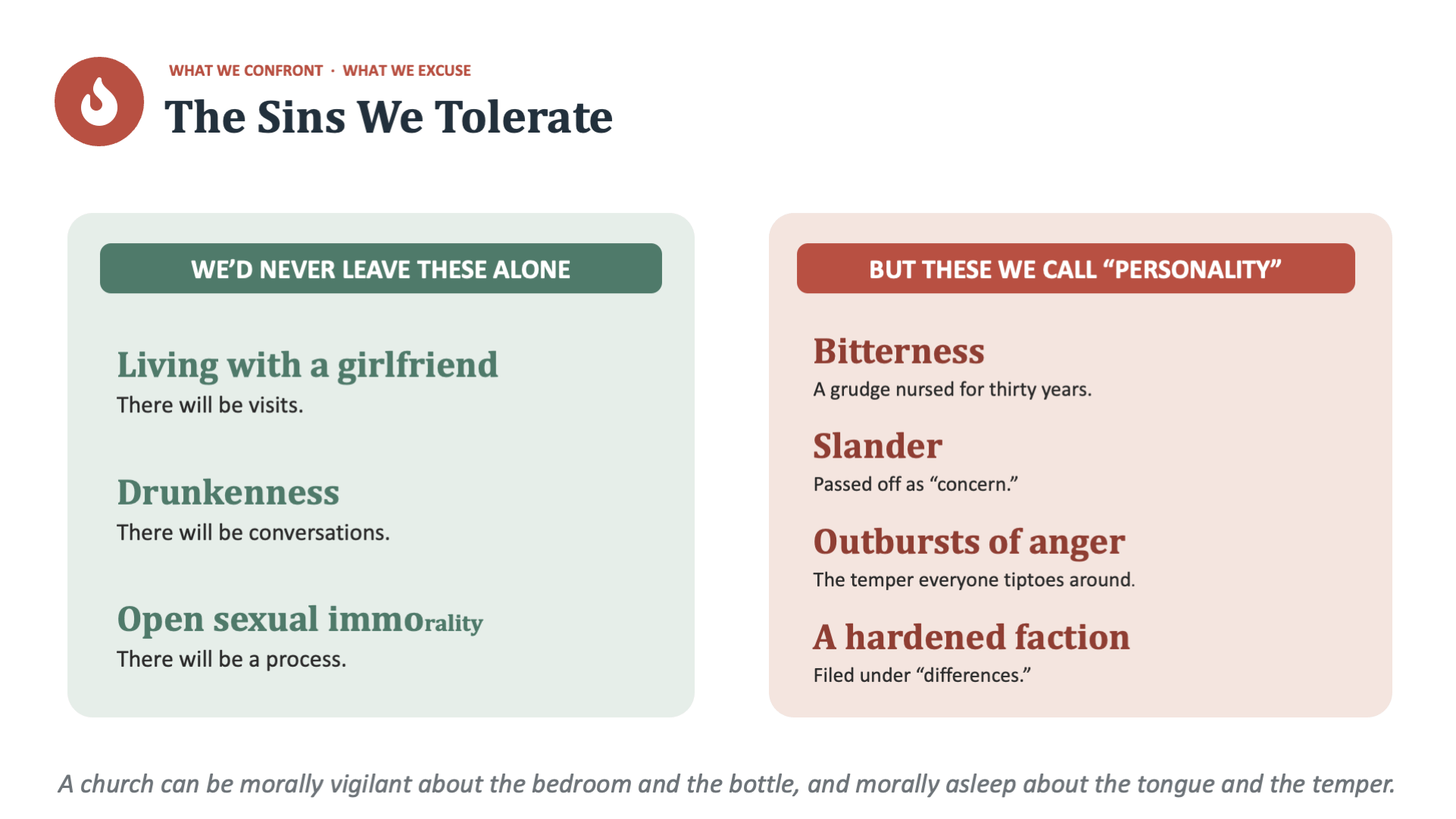
You know, there are certain sins we would never leave alone. Let a member move in with a girlfriend, or show up drunk, and the church knows what to do; there will be visits, conversations, a process. But let a brother spend years quietly slandering whoever crosses him, and somehow that’s just his personality. Let a sister’s outbursts be so reliable that three classes worth of people arrange their lives around not setting her off, and we call her “passionate” and tiptoe on. Let a faction harden until half the building won’t work with the other half, and we file it under “differences.” We have, without ever discussing it out loud, agreed to tolerate the works of the flesh that happen to be social.
But Paul put them on the same list as the sins we discipline, and James traced them to the same war within. The honest question for any congregation is not whether it has these sins. Every congregation does. The question is why it treats them as lesser. Bitterness gets a chair in the third row for thirty years. Slander gets passed off as concern. Strife gets renamed “standing for what’s right.” And all the while, the same people would be scandalized by sins that, on Paul’s own accounting, sit shoulder to shoulder with the ones we excuse. A church can be morally vigilant about the bedroom and the bottle and morally asleep about the tongue and the temper, and James says that a sleeping church is the one most likely to tear itself apart.
Back to the Appetite
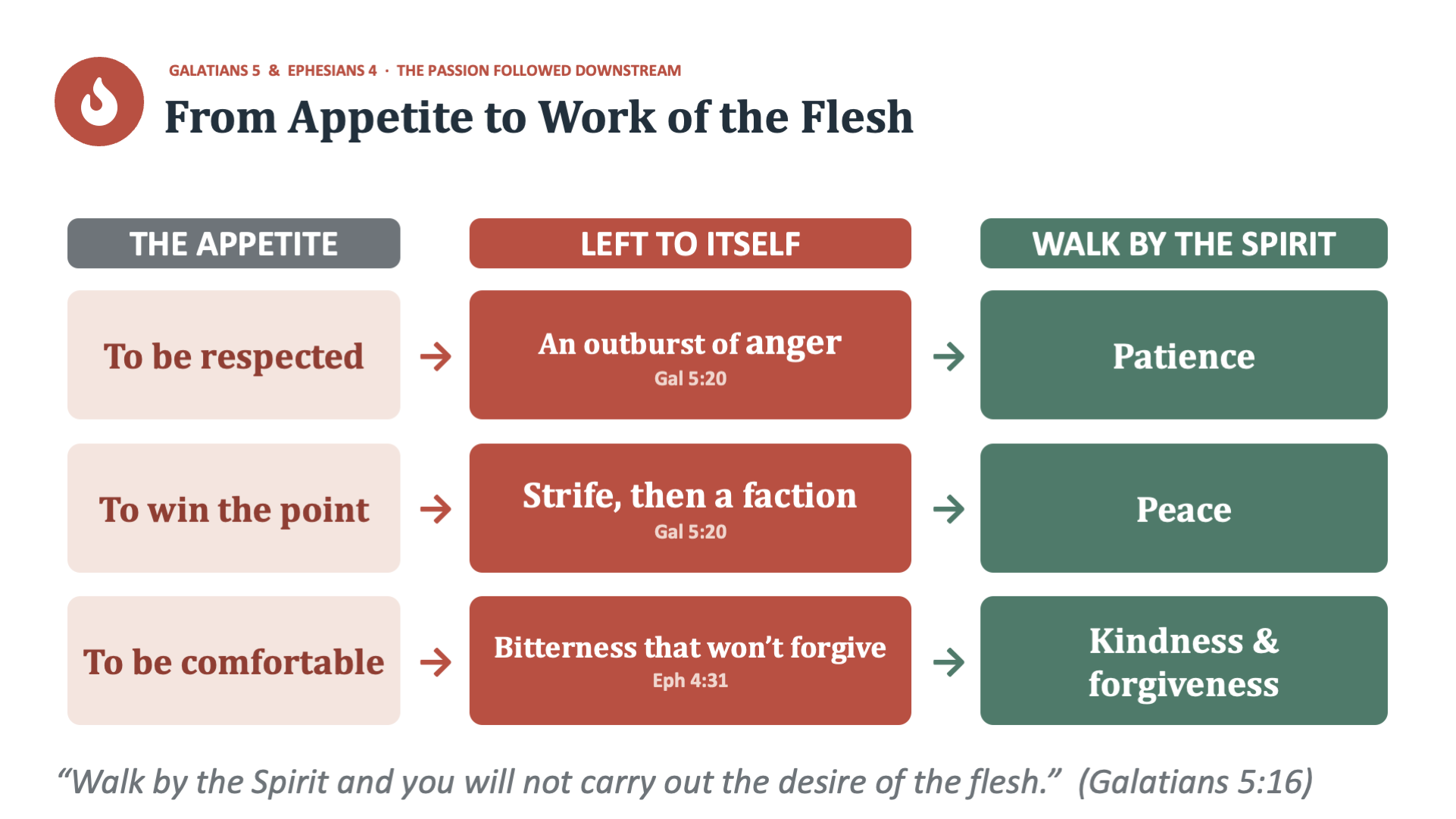
This is what James’s “passions” look like once they grow up and get dressed for church. The craving to be respected, left to itself, becomes an outburst of anger when the respect doesn’t come. The craving to win the point becomes strife, and then dissension, and then a faction. The craving to be comfortable becomes the bitterness that would rather nurse the wound than do the hard work of forgiving. If we will name the appetite honestly and then follow it one step further down the road, we’ll find it has a name on Paul’s lists too, and the heading over that list is “the works of the flesh.”
The Same Chapter Has Good News
It would be cruel to name all that and just walk away. Paul doesn’t stop at verse 21, and neither should we. The works of the flesh aren’t the last word in Galatians 5; they’re the setup. He provides us with another list, the one grown by a different power: “the fruit of the Spirit is love, joy, peace, patience, kindness, goodness, faithfulness, gentleness, and self-control” (Galatians 5:22-23). Read that with a church fight in mind.
Patience instead of the outburst.
Kindness instead of the slander.
Peace instead of the faction.
Self-control instead of the tongue that won’t quit.
Every social work of the flesh has a Spirit-grown opposite, and the opposite is exactly what holds a congregation together.
Any problem we face with this is never really about willpower: “walk by the Spirit and you will not carry out the desire of the flesh” (Gal 5:16). You don’t beat the passion by clenching your jaw and trying harder not to be bitter. You beat it by walking with Someone, by feeding a different appetite until the old one loses its grip. That’s exactly what James does when he sends the fighting brethren to their knees instead of at each other’s throats (James 4:7-10). The craving doesn’t get argued down. It gets crowded out.
So before you take a side in the next disagreement, turn the question inward. Not “what’s wrong with them,” but “what am I hungry for here, and which list is it feeding?” Identify the appetite. Hand it to God. Then ask the Spirit to grow the opposite. A church full of people doing that quiet, private work is a church with very little left to fight about.

I am enjoying this series because it reminds me to remain humble. To practice self-reflection before pointing my finger outward. To remember the grace I've received and to offer that grace to others before judgment and condemnation take hold. Thank you for going so deeply into what this actually looks like.